
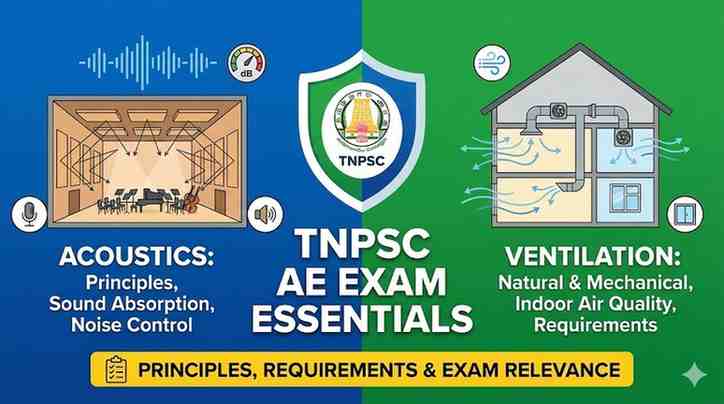
Acoustics & Ventilation: TNPSC AE Exam Essentials
Table of Contents
For aspiring Civil Engineers preparing for the TNPSC AE Civil Exam, a strong grasp of fundamental building requirements is non-negotiable. Among these, Acoustics and Ventilation stand out as critical areas, reflecting modern building design principles, occupant comfort, and statutory compliance. Understanding these topics isn't just about scoring marks; it's about developing the knowledge base essential for practical engineering roles.
Acoustics: Crafting Sound Environments
Acoustics, in the context of buildings, deals with the generation, transmission, and control of sound within a space. Its primary goal is to create environments that are acoustically comfortable, functional, and conducive to the intended activity.
Why Acoustics Matters in Buildings:
- Comfort & Well-being: Reduces stress and improves occupant satisfaction.
- Privacy: Essential in residential, office, and healthcare settings.
- Productivity: Minimizes distractions in workplaces and educational institutions.
- Health: Protects against noise-induced hearing loss and improves sleep quality.
- Functionality: Optimizes speech intelligibility in auditoriums and recording studios.
Key Acoustic Concepts for TNPSC AE:
- Sound Absorption: The process by which a material, structure, or object takes in sound energy when sound waves encounter it. Materials are rated by their Noise Reduction Coefficient (NRC).
- Sound Insulation: The reduction of sound transmission through a partition or barrier, measured by Sound Transmission Class (STC).
- Reverberation Time (RT60): The time it takes for sound to decay by 60 dB in a room after the sound source has stopped. Optimal RT60 varies by room function.
- Decibel (dB): The unit used to measure sound intensity.
- Building Materials: Understand how different materials (e.g., concrete, brick, drywall, specialized acoustic panels, double-glazed windows) perform in terms of sound absorption and insulation.
- National Building Code (NBC): Be aware of the NBC provisions related to permissible noise levels and acoustic design requirements for different building types.
Ventilation: Ensuring Fresh & Healthy Air
Ventilation is the process of replacing stale indoor air with fresh outdoor air. It is vital for maintaining good indoor air quality (IAQ), controlling temperature, and managing humidity within buildings.
Why Ventilation is Essential:
- Indoor Air Quality (IAQ): Removes pollutants, allergens, odors, and CO2, preventing 'sick building syndrome'.
- Thermal Comfort: Helps regulate indoor temperature and dissipate heat.
- Moisture Control: Prevents condensation, mold growth, and structural damage.
- Occupant Health: Reduces the spread of airborne diseases and improves overall respiratory health.
Types of Ventilation:
- Natural Ventilation: Relies on natural forces like wind pressure and thermal buoyancy (stack effect) through windows, doors, and vents. Factors include building orientation, window size and placement.
- Mechanical (Forced) Ventilation: Uses fans and ductwork to supply fresh air, exhaust stale air, or both.
- Exhaust Ventilation: Fans pull air out, creating negative pressure.
- Supply Ventilation: Fans push air in, creating positive pressure.
- Balanced Ventilation: Both supply and exhaust fans are used, often incorporating heat recovery ventilators (HRV) or energy recovery ventilators (ERV).
Key Ventilation Concepts for TNPSC AE:
- Air Changes Per Hour (ACH): A measure of how many times the air in a space is completely replaced within an hour.
- Airflow Rates: The volume of air moved per unit of time (e.g., Cubic Feet per Minute - CFM).
- Ductwork Design: Principles of sizing, routing, and material selection for efficient air distribution.
- Fan Types & Sizing: Understanding different fan characteristics and how to select them based on airflow requirements and static pressure.
- NBC & ASHRAE Standards: Familiarity with minimum ventilation rates and IAQ standards for various building occupancies.
Interplay and Exam Focus
It's important to recognize that acoustics and ventilation can sometimes have conflicting requirements (e.g., opening windows for natural ventilation can compromise acoustic insulation). A good civil engineer must understand how to integrate these aspects through thoughtful design.
For the TNPSC AE Civil Exam, expect questions that test your understanding of:
- Definitions and principles of sound and air movement.
- Properties of building materials related to acoustic absorption/insulation and thermal performance.
- Different types and methods of ventilation.
- Key parameters and units (dB, NRC, STC, ACH, CFM).
- Relevant provisions from the National Building Code (NBC) for both aspects.
- Basic design considerations and common solutions for acoustic and ventilation challenges.
By diligently studying these essential building requirements, you will not only be well-prepared for the TNPSC AE exam but also lay a strong foundation for a successful career in civil engineering, contributing to the design of healthier, more comfortable, and sustainable built environments.