
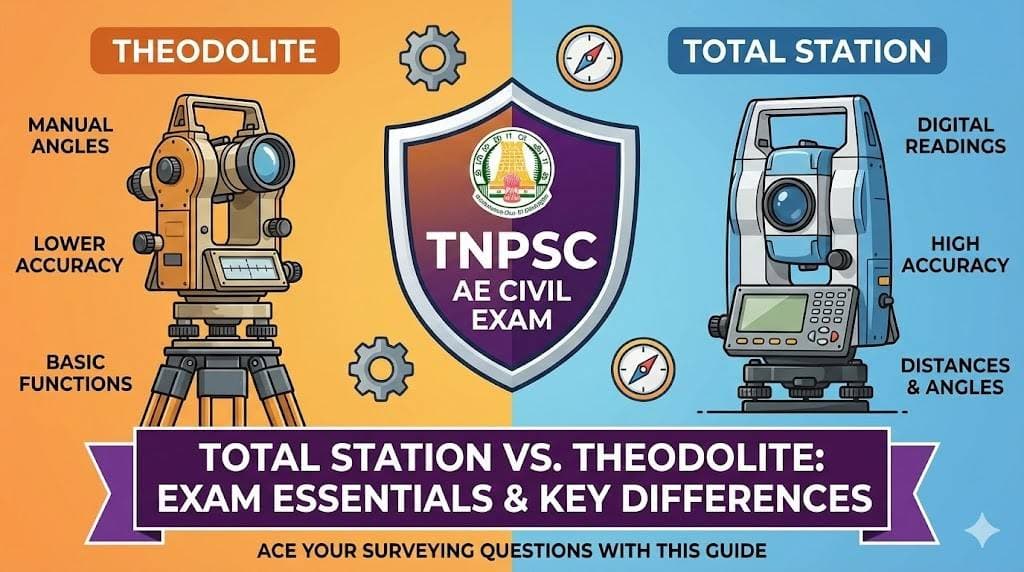
Total Station vs. Theodolite: TNPSC AE Civil Exam Essentials
Table of Contents
In the realm of civil engineering and surveying, instruments play a crucial role in gathering precise data for various projects. For aspirants preparing for the TNPSC AE Civil Exam, a clear understanding of fundamental surveying tools like the Theodolite and the Total Station is paramount. While both are used for angular measurements, their capabilities, operating principles, and applications differ significantly. This comprehensive guide will break down these differences, aiding your exam preparation.
Theodolite: The Angular Measurement Master
The Theodolite is a precision optical instrument primarily designed for measuring horizontal and vertical angles. It forms the backbone of traditional surveying methods.
Key Characteristics:
- Primary Function: Measures horizontal and vertical angles with high precision.
- Measurement Principle: Optical and mechanical systems (telescope, graduated circles, verniers/micrometers).
- Data Recording: Manual observation and recording in field books, prone to human error.
- Distance Measurement: Cannot directly measure distances. Requires separate instruments like a measuring tape or chain, or stadia methods (using theodolite and stadia rod).
- Coordinates: Cannot directly compute coordinates; calculations must be done manually or using external software.
- Portability: Generally robust and relatively lighter than early Total Stations.
Limitations:
- Time-consuming for complex surveys.
- Higher potential for manual errors in reading and recording.
- No direct data storage or processing capabilities.
Total Station: The Integrated Surveying Powerhouse
A Total Station is an electronic/optical instrument used for angle and distance measurements. It is essentially an electronic theodolite integrated with an Electronic Distance Measurement (EDM) unit and a microprocessor, making it a highly versatile and efficient tool.
Key Characteristics:
- Primary Function: Measures horizontal and vertical angles, and slope distances simultaneously.
- Measurement Principle: Electronic angle sensors and electromagnetic waves (infrared or laser) for distance measurement.
- Data Recording: Digital recording and storage in an internal memory or external data collector, significantly reducing errors.
- Distance Measurement: Measures distances quickly and accurately using EDM.
- Coordinates: Directly computes 3D coordinates (Easting, Northing, Elevation) based on measured angles and distances, and instrument setup data.
- Automation: Many models feature automation like auto-leveling, remote control, and robotic tracking.
Advantages:
- Higher accuracy and precision.
- Faster data acquisition and processing.
- Reduced human error due to digital recording.
- Integrated computations and data management.
- Can be interfaced with computers for further processing and CAD applications.
Key Differences: The Comparison for TNPSC AE
Understanding the distinctions is vital for answering objective questions in the TNPSC AE Civil Exam.
| FeatureTheodoliteTotal Station | ||
| Primary Function | Angular measurements (horizontal & vertical) | Angular measurements + Distance measurements |
| Distance Measurement | Indirect (Stadia method) or requires separate tape/chain | Direct and electronic via EDM |
| Coordinate Calculation | Manual calculation required | Automatic internal calculation |
| Data Recording | Manual field book entry | Digital storage in memory/data collector |
| Accuracy & Speed | Lower accuracy for overall survey, slower | Higher accuracy, significantly faster |
| Error Potential | Higher (reading, recording, calculation errors) | Lower (automated, digital) |
| Cost | Relatively lower | Relatively higher |
| Applications | Basic traversing, triangulation, setting out small areas | Extensive surveying (topographic, construction, cadastral), mapping, layout, GIS data collection |
| Learning Curve | Steeper for precision, manual calculations | Easier for operation, advanced for specific software |
Relevance for TNPSC AE Civil Exam
For the TNPSC AE Civil Exam, expect questions that test your conceptual understanding of these instruments:
- Definitions and Functions: What is the primary function of each instrument?
- Components: What are the key parts of a Theodolite (telescope, circles) vs. a Total Station (EDM, microprocessor)?
- Advantages/Disadvantages: When would you prefer a Total Station over a Theodolite and vice-versa?
- Measurement Principles: How does each measure angles and distances? (Optical/mechanical vs. Electronic/electromagnetic).
- Error Sources: Understand common errors associated with each.
- Application Areas: Identify suitable projects for each instrument.
Focus on the comparative aspects presented in the table above, as they are prime candidates for multiple-choice questions.
Conclusion
While the Theodolite laid the foundation for modern surveying, the Total Station represents a significant leap forward in efficiency, accuracy, and functionality, integrating multiple capabilities into one device. For the TNPSC AE Civil Exam, aspiring engineers must grasp not just what these instruments are, but also their operational principles, comparative advantages, and appropriate applications. A strong understanding will not only help you score well but also prepare you for practical challenges in the field.