Mastering Plastic Theory & Matrix Methods for TNPSC AE Civil
Table of Contents
Aspiring Civil Engineers aiming for the TNPSC AE Civil Exam know the importance of a strong foundation in Structural Analysis. Among the crucial topics, Plastic Theory and Matrix Methods often stand out due to their practical relevance and analytical depth. Understanding these concepts thoroughly can significantly boost your scores and confidence. Let's delve into what makes them vital for your exam preparation.
Plastic Theory: Unlocking Ultimate Structural Strength
Traditionally, structural analysis primarily focused on elastic behavior, ensuring structures remain within their elastic limit. However, Plastic Theory offers a more realistic approach by considering the ultimate load-carrying capacity of a structure beyond its elastic limit. It acknowledges the material's ability to deform plastically before failure, leading to more economical and robust designs.
Key Concepts for TNPSC AE:
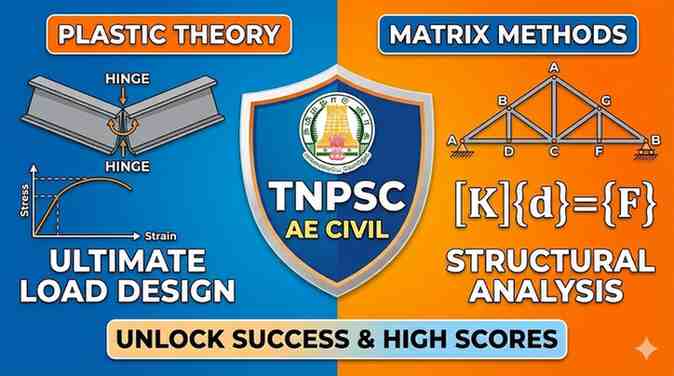
- Plastic Hinge: A yielded section in a structural member where large plastic rotations can occur at a constant plastic moment. It acts like a frictionless hinge at the collapse load.
- Plastic Moment (Mp): The maximum bending moment a section can resist when the entire cross-section has yielded. Mp = fy * Zp, where fy is yield stress and Zp is the plastic section modulus.
- Shape Factor: The ratio of plastic section modulus (Zp) to elastic section modulus (Ze). It indicates the reserve strength beyond yielding. (e.g., for a rectangular section, it's 1.5; for a circular section, it's 1.7).
- Collapse Load: The load at which a structure forms enough plastic hinges to become a mechanism and undergoes unlimited deformation.
- Upper Bound and Lower Bound Theorems: Crucial for determining the collapse load. The upper bound theorem states that any assumed mechanism will give a collapse load greater than or equal to the true collapse load. The lower bound theorem states that any safe stress distribution will give a collapse load less than or equal to the true collapse load.
For TNPSC AE, expect questions on definitions, basic calculations of plastic moment and shape factor for simple sections, and understanding the concept of collapse mechanisms.
Matrix Methods: The Power of Systematic Structural Analysis
As structures become more complex (e.g., multi-story frames, trusses with numerous members), traditional methods like slope-deflection or moment distribution become cumbersome. Matrix Methods provide a systematic, computer-friendly approach to analyze such structures. They form the backbone of modern structural analysis software.
Key Methods for TNPSC AE:
1. Flexibility Method (Force Method)
- Principle: Based on force-displacement relationships and ensuring compatibility conditions are met.
- Procedure: Redundant forces are identified, and flexibility coefficients (deflections due to unit forces) are calculated. The method solves for redundant forces.
- Matrix Form: [F]{X} + {DL} = {0}, where [F] is the flexibility matrix, {X} are redundant forces, and {DL} are displacements due to external loads.
2. Stiffness Method (Displacement Method)
- Principle: Based on displacement-force relationships and ensuring equilibrium conditions are met at joints. It's generally preferred for computer analysis.
- Procedure: Degrees of freedom (unknown joint displacements) are identified. Stiffness coefficients (forces due to unit displacements) are calculated. The method solves for unknown displacements.
- Matrix Form: [K]{Δ} = {P}, where [K] is the global stiffness matrix, {Δ} are unknown joint displacements, and {P} are applied joint forces.
- Element Stiffness Matrix: Represents the force-displacement relationship for individual structural elements (e.g., beam element, truss element). These are assembled to form the global stiffness matrix.
For TNPSC AE, focus on the fundamental principles of each method, their applications, the concept of degrees of freedom, and how element stiffness matrices are assembled into a global matrix. Basic understanding of matrix operations (addition, multiplication, inverse) is also helpful.
TNPSC AE Civil Exam Strategy for These Topics
- Conceptual Clarity: Understand the 'why' and 'how' behind each theory.
- Formulas: Memorize key formulas for plastic moment, shape factor, and basic matrix relations.
- Definitions: Be precise with terms like plastic hinge, collapse load, degrees of freedom, etc.
- Practice Problems: Solve simple numerical problems, especially for Plastic Theory. For Matrix Methods, focus on setting up the problem rather than complex matrix inversions.
- Previous Year Papers: Analyze past TNPSC AE questions to gauge the depth and type of questions asked.
Conclusion
Plastic Theory and Matrix Methods are indispensable tools in a Civil Engineer's arsenal. For the TNPSC AE Civil Exam, mastering these topics will not only help you score well but also lay a strong foundation for your professional career. Dedicate sufficient time to understand the core principles, practice problems, and approach the exam with confidence. Happy studying!