
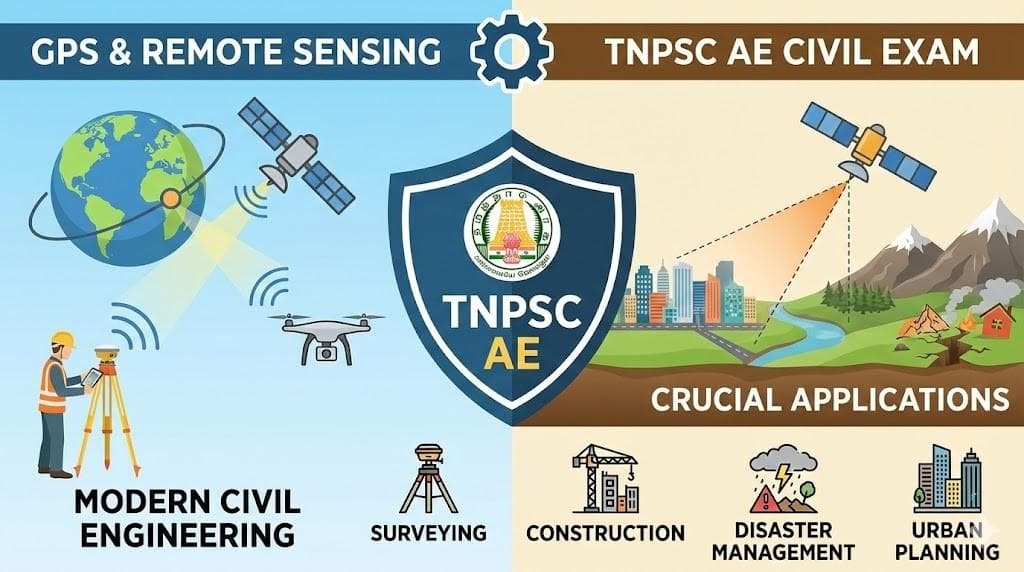
GPS & Remote Sensing in Modern Civil Engineering (TNPSC AE)
Table of Contents
Civil engineering, the backbone of infrastructure development, is continuously evolving with technological advancements. Among these, Global Positioning System (GPS) and Remote Sensing (RS) have emerged as indispensable tools, revolutionizing how projects are planned, executed, and managed. For aspirants preparing for the TNPSC AE Civil Exam, a solid understanding of these technologies is not just beneficial but essential, as they frequently feature in the syllabus. This post delves into the applications and significance of GPS and Remote Sensing in modern civil engineering.
GPS in Civil Engineering
GPS, a satellite-based navigation system, provides precise location and time information globally. Its applications in civil engineering are diverse and critical.
Surveying and Mapping
GPS has largely replaced traditional surveying methods, offering faster, more accurate data for topographical mapping, boundary demarcation, and site layout. RTK (Real-Time Kinematic) GPS provides centimeter-level accuracy for high-precision tasks.
Construction Layout and Machine Control
GPS-enabled machinery (excavators, bulldozers, graders) can operate with extreme precision, following digital designs directly. This reduces errors, saves time, and optimizes material usage.
Monitoring Structural Health and Deformation
High-precision GPS receivers can monitor subtle movements in bridges, dams, and high-rise buildings, detecting potential structural failures due to seismic activity, ground settlement, or material fatigue.
Traffic Management and Transportation Planning
GPS data informs intelligent transportation systems (ITS), aiding in traffic flow optimization, route planning, and monitoring public transport. It's crucial for designing efficient road networks.
Remote Sensing in Civil Engineering
Remote Sensing involves acquiring information about an object or phenomenon without making physical contact. Satellites, aircraft, and drones equipped with various sensors collect data, which is then analyzed to provide valuable insights.
Site Investigation and Geotechnical Applications
Satellite imagery, LiDAR (Light Detection and Ranging), and radar data help in geological mapping, identifying soil types, assessing landslide risks, and locating suitable construction sites.
Environmental Impact Assessment (EIA)
Remote sensing monitors changes in land use, vegetation cover, water quality, and air pollution, crucial for assessing and mitigating the environmental impact of civil engineering projects.
Disaster Management
Post-disaster assessment (floods, earthquakes, landslides) relies heavily on remote sensing to map affected areas, identify damage, and guide relief efforts. Pre-disaster mapping helps in vulnerability assessment.
Urban Planning and Infrastructure Development
Remote sensing provides up-to-date information on urban sprawl, population density, and existing infrastructure, aiding planners in developing sustainable cities and efficient utility networks.
Resource Management
From monitoring water bodies and reservoir levels to assessing forest cover and agricultural land, remote sensing plays a vital role in sustainable resource management for infrastructure support.
Benefits for Civil Engineers
The integration of GPS and Remote Sensing brings numerous advantages:
- Enhanced Accuracy and Precision: Minimizes errors in measurements and construction.
- Increased Efficiency and Productivity: Automates tasks, reduces field time, and speeds up project completion.
- Improved Safety: Reduces human exposure to hazardous environments during surveying or monitoring.
- Cost-Effectiveness: Optimizes resource allocation, reduces material waste, and prevents costly rework.
- Data-Driven Decision Making: Provides comprehensive, up-to-date data for informed planning and design.
Relevance for TNPSC AE Civil Exam
Candidates for the TNPSC AE Civil Exam must grasp the theoretical principles and practical applications of GPS and Remote Sensing. Questions often cover:
- Basic principles of GPS operation (satellites, receivers, trilateration).
- Types of remote sensing platforms and sensors (passive vs. active, LiDAR, radar).
- Specific applications in surveying, transportation, water resources, and urban planning.
- Advantages and limitations of these technologies.
A strong understanding will significantly boost your performance in the exam.
Conclusion
GPS and Remote Sensing are no longer niche technologies but foundational components of modern civil engineering. Their ability to provide accurate, timely, and comprehensive data has transformed project lifecycle management, from initial planning to long-term maintenance. As civil infrastructure becomes more complex and demands for sustainability grow, the importance of these technologies will only continue to amplify. Mastering them is key for any aspiring civil engineer, especially those aiming to clear competitive exams like the TNPSC AE Civil Exam.