
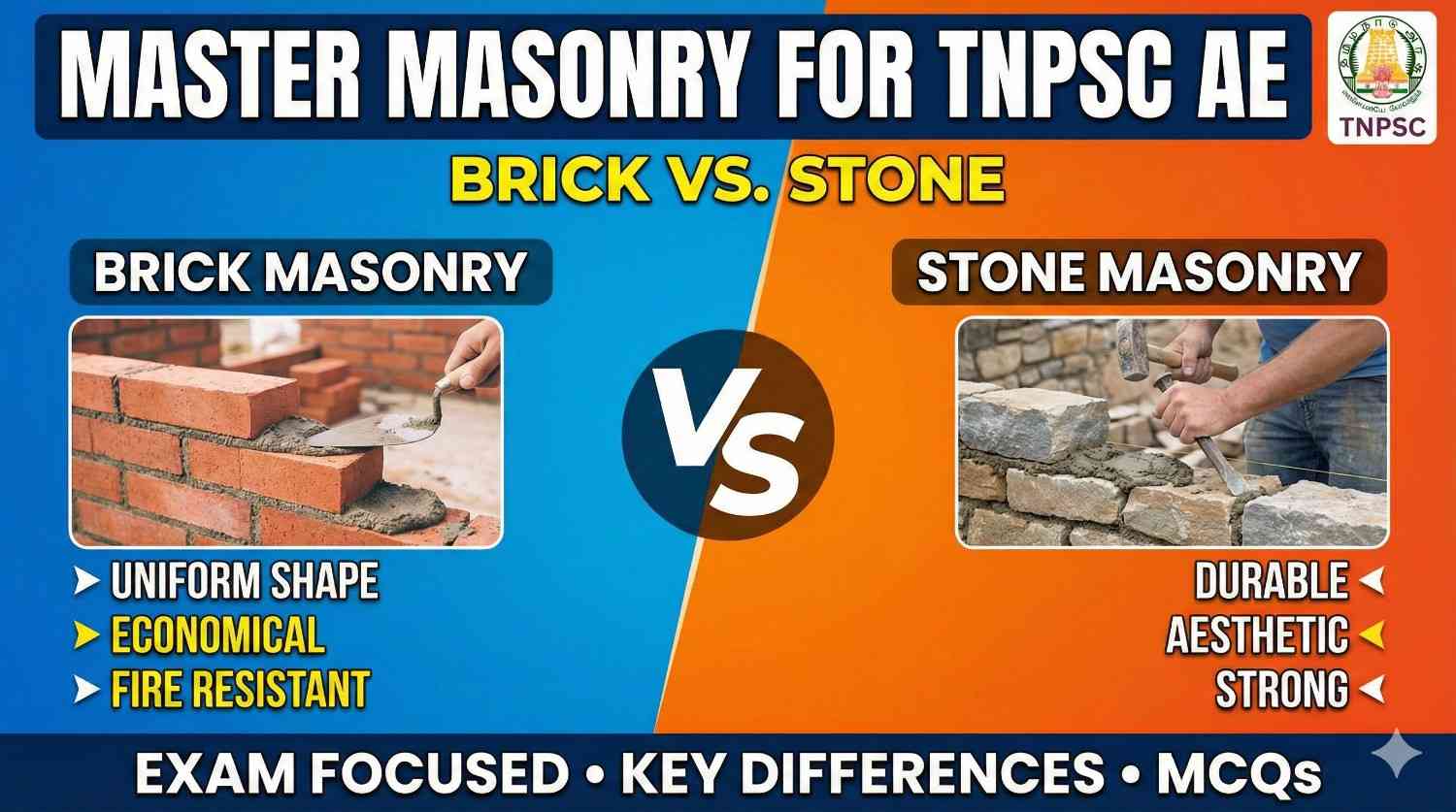
Brick vs. Stone: Master Masonry for TNPSC AE Exam
Table of Contents
For aspirants gearing up for the TNPSC AE Civil Engineering exam, a solid understanding of basic construction materials is non-negotiable. Among these, masonry materials like brick and stone are fundamental, with their properties, applications, and comparative advantages frequently tested. This comprehensive guide dissects brick and stone masonry, equipping you with the knowledge to confidently tackle related questions.
Understanding Brick Masonry
Brick masonry involves construction using standardized units (bricks) laid in mortar. Bricks are typically manufactured from clay and are uniform in size and shape, making construction relatively straightforward.
Key Characteristics & Properties for TNPSC AE:
- Composition: Predominantly clay, fired to harden.
- Standard Size (India): 19 cm x 9 cm x 9 cm (nominal size with mortar: 20 cm x 10 cm x 10 cm).
- Crushing Strength: Varies by class. First-class bricks minimum 10 N/mm², Second-class minimum 7 N/mm².
- Water Absorption: First-class bricks should not absorb more than 20% by weight after 24 hours immersion; Second-class not more than 22%.
- Efflorescence: Minimal to Nil for good quality bricks.
- Thermal Insulation: Good due to pores.
- Fire Resistance: Good, especially for fire bricks.
- Bonds: English bond (strongest), Flemish bond (aesthetic), Header bond, Stretcher bond.
- Frog: Indentation on brick top for keying with mortar.
Advantages:
- Uniform size and shape facilitate easier and faster construction.
- Economical due to mass production and local availability.
- Good thermal and sound insulation properties.
- High fire resistance.
- Requires less skilled labor compared to stone masonry.
Disadvantages:
- Lower compressive strength than many stones.
- Less durable in extreme weather conditions if not properly treated.
- Limited aesthetic appeal compared to natural stone.
Understanding Stone Masonry
Stone masonry utilizes natural stones, either dressed or undressed, laid in mortar. It's one of the oldest forms of construction, renowned for its strength, durability, and aesthetic appeal.
Key Characteristics & Properties for TNPSC AE:
- Composition: Natural rock (igneous, sedimentary, metamorphic). Examples: Granite, Basalt, Sandstone, Limestone, Marble, Slate.
- Crushing Strength: Generally higher than bricks. Granite > 100 N/mm², Basalt > 150 N/mm².
- Water Absorption: Varies greatly. Dense stones like granite have very low absorption (< 1%); porous stones like sandstone higher.
- Specific Gravity: Ranges from 2.5 to 3.0 for most common building stones.
- Durability: Highly durable and weather-resistant.
- Hardness: High (e.g., Granite, Basalt).
- Types of Masonry:Rubble Masonry: Uses undressed or roughly dressed stones. Less costly, rustic appearance.
- Ashlar Masonry: Uses finely dressed stones with uniform bed and joint thickness. Expensive, high aesthetic appeal, stronger.
Advantages:
- Exceptional durability and longevity.
- High compressive strength, suitable for heavy loads.
- Superior aesthetic appeal and natural beauty.
- Excellent resistance to fire and weathering.
- Requires minimal maintenance.
Disadvantages:
- High initial cost, especially for dressed stones.
- Irregular shapes often require highly skilled labor for proper laying.
- Heavy, requiring strong foundations.
- Construction is slower and more labor-intensive.
Brick vs. Stone: A Comparative Analysis for TNPSC AE
Understanding these differences is crucial for exam questions that often involve choosing the appropriate material for specific scenarios.
| Feature Brick Masonry Stone Masonry | ||
| Material | Manufactured clay units | Natural rock |
| Cost | Relatively low | High (especially for dressed stones) |
| Strength | Moderate (7-15 N/mm²) | High (often > 100 N/mm²) |
| Durability | Good, but less than stone | Excellent, very long-lasting |
| Workability | Easy to lay due to uniform size | Difficult, requires skilled labor for dressing and laying |
| Aesthetics | Uniform, but limited variety | Natural, diverse textures and colors |
| Weight | Lighter per unit volume | Heavier per unit volume |
| Availability | Widely available | Varies regionally |
| Maintenance | Moderate | Low |
| Insulation | Good thermal and sound | Good thermal, less sound due to density |
Choosing the Right Material: TNPSC AE Perspective
The choice between brick and stone masonry depends on various factors, which are often the basis of TNPSC AE exam questions:
- Structural Requirements: For very heavy loads or structures requiring extreme durability (e.g., retaining walls, dams in some cases), stone is often preferred. For general building walls, brick is sufficient.
- Budget: Brick is generally more economical for large-scale projects where cost is a major constraint.
- Aesthetics: Stone is chosen for its natural beauty and grandeur, often for prestigious buildings or facades.
- Availability: Local availability of either material can significantly influence the choice and cost.
- Climate: For areas prone to extreme weathering, durable stone might be a better choice.
- Skilled Labor: If skilled masons are scarce, brick masonry is easier to execute.
Conclusion
Both brick and stone masonry have distinct advantages and disadvantages, making them suitable for different applications in civil engineering. For the TNPSC AE exam, remember to focus on the quantitative properties (strength, absorption), standard dimensions, types of masonry (rubble, ashlar; various bonds), and the comparative aspects. A thorough understanding of these concepts will not only help you ace the exam but also lay a strong foundation for your career as a civil engineer.