TNPSC AE 2026 Strategy: Month-by-Month Blueprint
Table of Contents
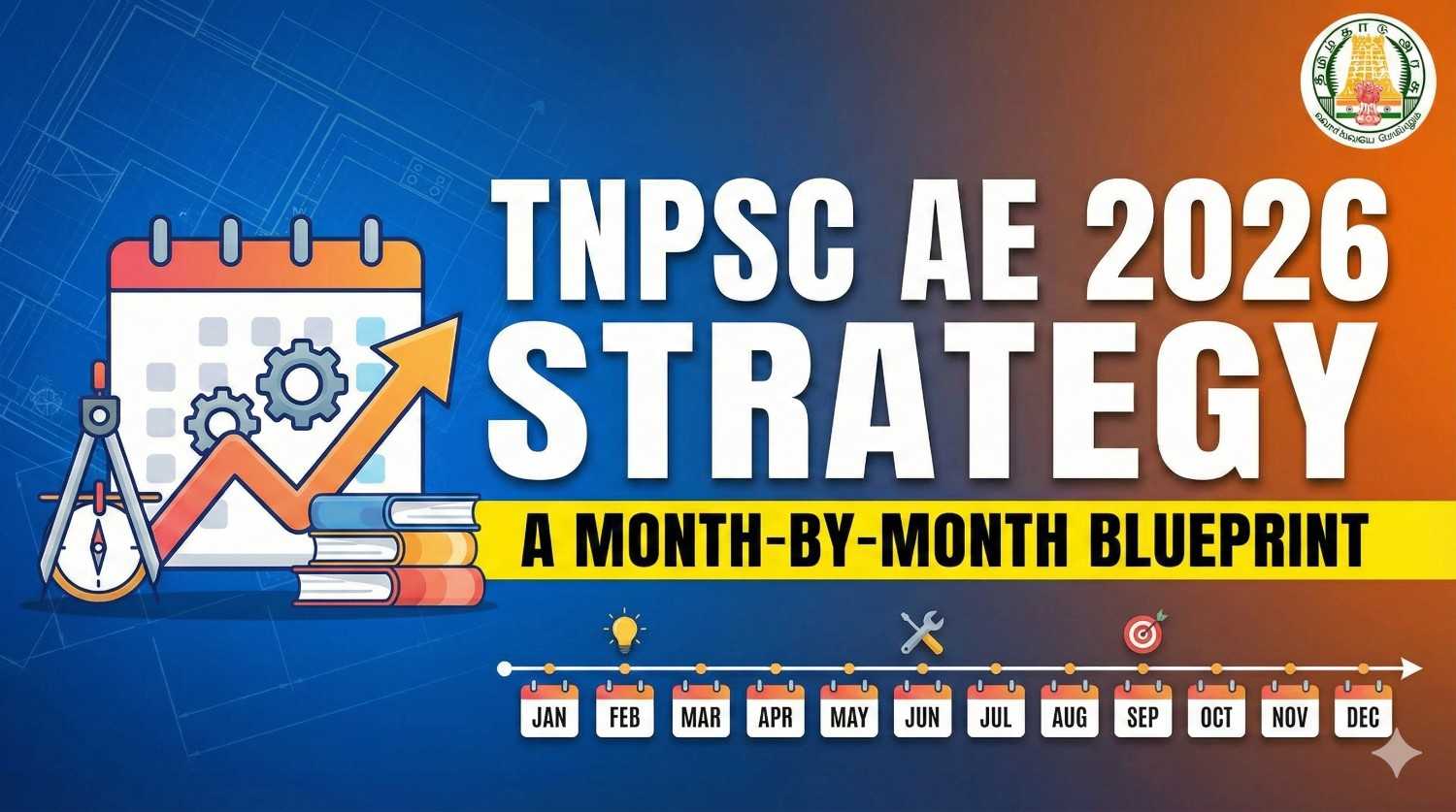
Building Your TNPSC AE 2026 Strategy: A Month-by-Month Blueprint
The Tamil Nadu Public Service Commission (TNPSC) Assistant Engineer (AE) examination is a highly sought-after opportunity for engineering graduates aspiring to serve in various departments across the state. While the exam date for 2026 might seem far away, successful candidates know that early and strategic preparation is key. This detailed month-by-month blueprint will guide you through a structured approach to conquer the TNPSC AE 2026 exam.
Understanding the TNPSC AE Exam Structure
Before diving into the monthly plan, it's crucial to understand the exam's components:
- Paper-I: Subject Paper (Engineering Discipline specific – e.g., Civil, Mechanical, EEE). This carries the highest weightage.
- Paper-II: General Studies (comprising General Science, Current Events, Geography, History & Culture of India, Indian Polity, Indian Economy, Indian National Movement, History, Culture, Heritage and Socio-Political Movements in Tamil Nadu, Development Administration in Tamil Nadu) and Aptitude & Mental Ability Test.
A balanced approach focusing on both papers is essential for success.
Your 12-Month TNPSC AE 2026 Preparation Blueprint
Months 1-2 (May - June 2025): Foundation & Syllabus Deconstruction
- Familiarization: Thoroughly go through the official TNPSC AE 2026 syllabus for your specific engineering discipline and Paper-II. Understand the exam pattern, marking scheme, and previous year cut-offs.
- Resource Gathering: Collect standard textbooks, reference materials, and coaching institute notes (if applicable). Prioritize quality over quantity.
- Core Technical Subjects: Identify 2-3 high-weightage core engineering subjects (e.g., Structural Analysis, Fluid Mechanics, Electrical Circuits, Thermodynamics) and begin their systematic study. Focus on conceptual clarity.
- Basic Aptitude: Dedicate 1-2 hours per week to fundamental Aptitude topics like number systems, percentages, ratios, and time & work.
Months 3-4 (July - August 2025): Technical Depth & Problem Solving
- Deep Dive: Continue with your core technical subjects. Focus on understanding derivations, formulas, and their applications.
- Practice Problems: Solve a wide variety of problems from standard textbooks and practice books. Don't just read solutions; try to solve them yourself.
- Short Notes: Start making concise notes for each topic, including key formulas, definitions, and important concepts. These will be invaluable for quick revision.
- General Studies Introduction: Introduce one GS subject, preferably 'History, Culture, Heritage and Socio-Political Movements in Tamil Nadu' or 'Indian Polity', as they are often fundamental.
Months 5-6 (September - October 2025): Expanding Technical & GS Base
- New Technical Subjects: Pick up 2-3 more technical subjects. Maintain a balance between theoretical and problem-oriented subjects.
- Consistent Practice: Regularly revise previously studied technical subjects to ensure retention.
- General Studies Expansion: Continue with your chosen GS subject and introduce another, such as 'Geography' or 'Indian Economy'. Focus on understanding concepts rather than just memorizing facts.
- Current Affairs: Start reading a good daily newspaper and a monthly current affairs magazine. Make brief notes on important national, international, and state-level events.
Months 7-8 (November - December 2025): GS Deep Dive & Integrated Revision
- Complete Technical Syllabus: Aim to complete the first pass of your entire technical syllabus by the end of December. Prioritize subjects based on weightage.
- General Studies Completion: Focus on covering the remaining GS subjects like 'General Science', 'Development Administration in Tamil Nadu', and 'Indian National Movement'.
- Weekly Revision: Dedicate at least one full day a week for comprehensive revision of all subjects covered so far (Technical, GS, Aptitude).
- Topic-wise Mock Tests: Start attempting topic-wise or subject-wise mock tests to assess your understanding and identify weak areas.
Months 9-10 (January - February 2026): Comprehensive Revision & Mock Tests
- Full Syllabus Revision: This is a critical phase for intensive revision of the entire syllabus using your short notes and highlighted textbooks.
- Full-Length Mock Tests: Start attempting 1-2 full-length mock tests per week under exam conditions. This will help you manage time, improve speed, and build stamina.
- Performance Analysis: After each mock test, thoroughly analyze your performance. Identify areas where you consistently make mistakes – be it conceptual gaps, silly errors, or time management issues.
- Previous Year Papers: Solve as many previous year TNPSC AE question papers as possible. This provides insights into the actual exam pattern and question types.
Months 11-12 (March - April 2026): Final Polish & Exam Readiness
- Intensive Short-Note Revision: Focus solely on revising from your concise notes. Avoid starting any new topics.
- Accuracy & Speed: Practice questions with a focus on increasing both accuracy and speed. Work on eliminating silly mistakes.
- Weak Area Strengthening: Dedicate extra time to your identified weak areas, revisiting concepts and practicing specific problem types.
- Mental & Physical Well-being: Maintain a healthy diet, get adequate sleep, and incorporate light exercise. Stay positive and confident.
- Final Brush-up: In the last week, only revise key formulas, definitions, and high-yield topics. Avoid last-minute cramming.
Key Tips for Sustained Success
- Consistency is Key: Regular study, even for short durations, is more effective than sporadic long sessions.
- Quality over Quantity: Focus on understanding concepts thoroughly rather than just completing topics superficially.
- Stay Updated with Current Affairs: Current events play a significant role in Paper-II.
- Regular Self-Assessment: Mock tests and previous year papers are indispensable tools for tracking progress and refining your strategy.
- Believe in Yourself: A positive mindset and strong self-belief are crucial throughout your preparation journey.
Preparing for the TNPSC AE 2026 exam is a marathon, not a sprint. By following this month-by-month blueprint and staying dedicated, you can systematically build your knowledge, enhance your skills, and confidently stride towards securing your dream government job. Good luck!