
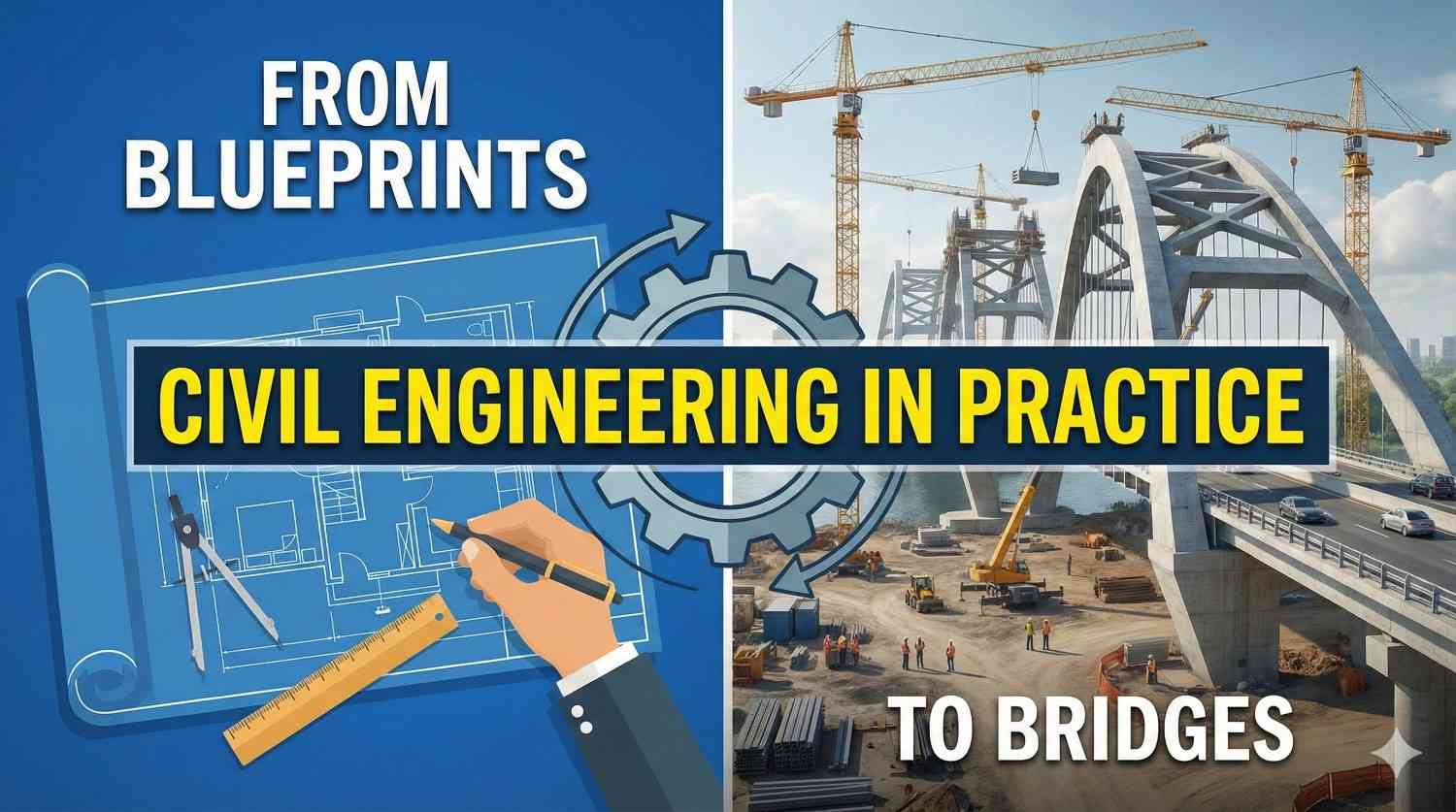
From Blueprints to Bridges: Civil Engineering in Practice
Table of Contents
Civil engineering is the backbone of our modern world, responsible for designing, constructing, and maintaining the physical and naturally built environment. But what exactly do civil engineers study in their textbooks, and more importantly, where do these complex theories find their practical application in the real world?
The Foundations: What Civil Engineering Books Teach
Civil engineering curricula are diverse, covering a wide array of specialized fields. Here are some core subjects you'll encounter in civil engineering textbooks:
- Structural Engineering: Books cover mechanics of materials, structural analysis, and the design of structures using concrete, steel, timber, and masonry. You learn about forces, stresses, strains, and how to ensure a structure can safely withstand loads.
- Geotechnical Engineering: These texts delve into soil mechanics, foundation engineering, and rock mechanics. They teach about soil properties, bearing capacity, settlement, slope stability, and how to design foundations that support structures on various ground conditions.
- Transportation Engineering: Books focus on highway design, traffic engineering, railway engineering, and airport planning. You study road geometry, traffic flow theory, pavement design, and the logistics of moving people and goods efficiently.
- Water Resources Engineering: Subjects include hydrology, hydraulics, fluid mechanics, water supply engineering, wastewater treatment, and flood control. You learn about water flow, precipitation, river mechanics, and designing systems for water management.
- Environmental Engineering: This area covers waste management (solid and hazardous), air pollution control, water quality, and sustainable engineering practices. Textbooks teach about mitigating environmental impacts and designing eco-friendly solutions.
- Construction Engineering and Management: These books focus on project planning, scheduling, cost estimation, construction methods, safety management, and legal aspects of construction.
- Surveying and Geomatics: Textbooks introduce principles of land surveying, GPS, GIS (Geographic Information Systems), and remote sensing, essential for accurate mapping and site layout.
Bringing Theory to Life: Practical Applications
The beauty of civil engineering lies in seeing complex theories become tangible realities. Here's where the knowledge from those books is practically applied:
1. Structural Engineering: Building the World's Framework
- Buildings: From skyscrapers to residential homes, every beam, column, and slab is designed using principles of structural analysis and concrete/steel design learned in textbooks.
- Bridges: Whether it's a suspension bridge spanning a river or a simple pedestrian overpass, the forces, material strengths, and stability are meticulously calculated.
- Dams and Tunnels: These massive structures require a deep understanding of structural mechanics to withstand immense pressures and ground movements.
2. Geotechnical Engineering: Ensuring Stable Foundations
- Foundation Design: Every building, bridge, and tower needs a stable foundation. Geotechnical engineers analyze soil samples (from textbook procedures!) to determine the best type of foundation (shallow, deep, piles, rafts) and its dimensions.
- Slope Stability: Designing stable embankments for roads or preventing landslides involves applying soil mechanics principles.
- Retaining Walls: Structures that hold back earth, like those along highways or basements, are designed based on soil pressure theories.
3. Transportation Engineering: Connecting Communities
- Roads and Highways: Designing the curves, slopes, and pavement thickness of roads, as well as optimizing traffic light timings, directly applies concepts from highway and traffic engineering textbooks.
- Airports and Railways: Designing runways, taxiways, railway tracks, and station layouts requires specialized knowledge of material science and geometric design.
- Public Transit Systems: Planning efficient bus routes, metro lines, and traffic management strategies relies on transportation planning and traffic flow analysis.
4. Water Resources Engineering: Managing Our Most Vital Resource
- Water Treatment Plants: Designing the filtration, chemical treatment, and distribution networks for clean drinking water.
- Wastewater Treatment Systems: Engineering plants to safely treat and discharge sewage, protecting public health and the environment.
- Dams and Flood Control: Designing spillways, reservoirs, and levees to manage water levels and prevent flooding, using hydraulic and hydrologic models.
- Irrigation Systems: Developing efficient ways to deliver water to agricultural lands.
5. Environmental Engineering: Protecting Our Planet
- Waste Management Facilities: Designing landfills, recycling plants, and waste-to-energy systems to handle solid waste effectively.
- Air Pollution Control: Engineering systems to reduce emissions from industrial sources.
- Sustainable Infrastructure: Integrating green building techniques, renewable energy sources, and sustainable material choices into projects.
6. Construction Engineering & Management: Bringing Designs to Life
- Project Execution: Applying project management principles to plan, schedule, budget, and oversee construction projects from start to finish.
- Site Supervision: Ensuring that construction methods, material quality, and safety protocols adhere to design specifications and industry standards.
7. Surveying & Geomatics: Precision and Positioning
- Site Layout: Using survey instruments and GPS data to precisely mark out building footprints, road alignments, and property boundaries on a construction site.
- Mapping and GIS: Creating detailed maps and geographic databases for urban planning, resource management, and infrastructure development.
Conclusion
Civil engineering books provide the theoretical framework – the scientific principles, formulas, and design methodologies – that are indispensable for creating the built environment. Every road you drive on, every building you enter, every drop of clean water you drink, and every bridge you cross is a testament to these theories being meticulously applied by skilled civil engineers. The practical application is where the equations leave the page and rise as monumental testaments to human ingenuity and engineering prowess, shaping the world we live in.