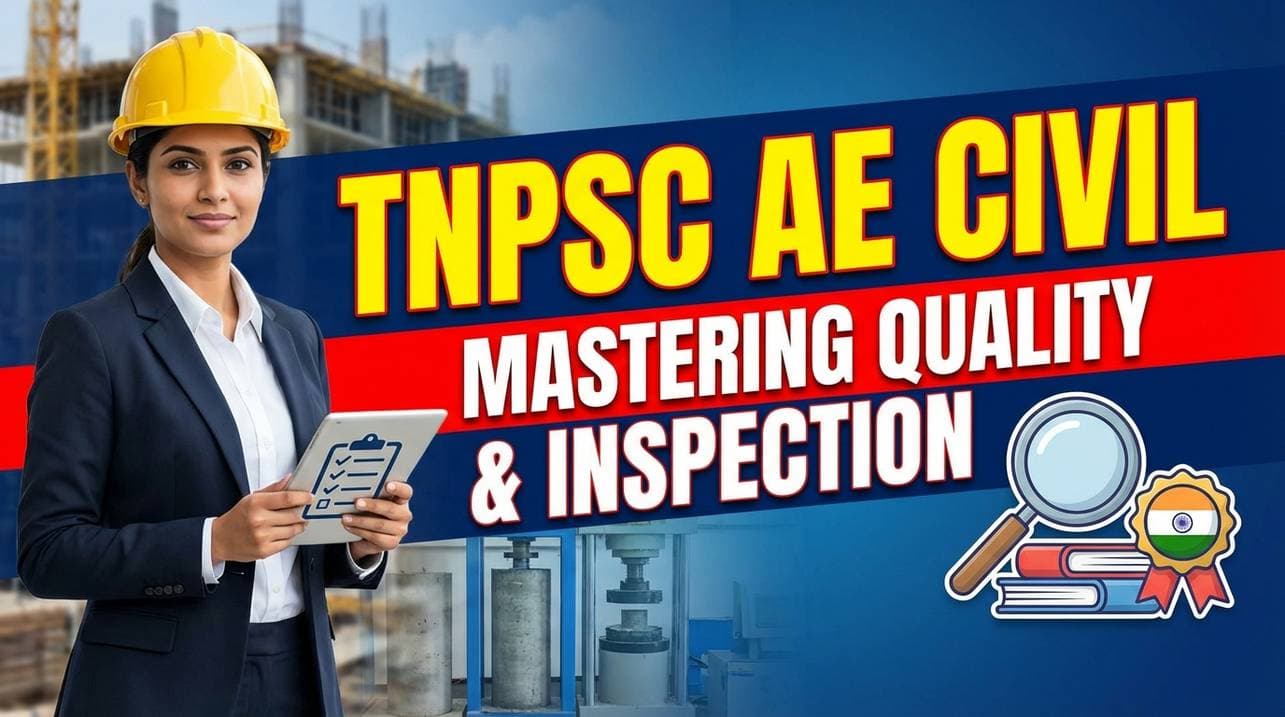
TNPSC AE Civil: Mastering Construction Quality & Inspection
Table of Contents
For aspiring Assistant Engineers (AEs) preparing for the TNPSC Civil Services Exam, a thorough understanding of Quality Control (QC) and Inspection in construction projects is not just theoretical knowledge but a cornerstone of practical engineering. The integrity, safety, and longevity of public infrastructure projects, from roads to buildings, hinges on rigorous quality management. This blog post delves into the essentials of QC and Inspection, crucial for both your exam success and future professional responsibilities.
Why Quality Control & Inspection Matter for an AE
As an Assistant Engineer, you will be on the front lines, responsible for supervising and executing construction works. Your ability to enforce quality standards directly impacts:
- Structural Integrity & Safety: Preventing failures and ensuring the safety of users.
- Durability & Longevity: Maximizing the lifespan of structures, reducing maintenance costs.
- Cost-Effectiveness: Avoiding rework, material waste, and legal disputes.
- Adherence to Specifications: Ensuring projects meet design requirements and contractual obligations.
- Public Trust: Delivering reliable and high-quality infrastructure for the community.
Key Definitions: QA, QC, and Inspection
- Quality Assurance (QA): A broader, proactive system-oriented approach focused on preventing defects. It involves setting up processes, procedures, and standards to ensure quality throughout the project lifecycle. Think of it as defining how quality will be achieved.
- Quality Control (QC): A reactive, product-oriented process focused on identifying and correcting defects. It involves actual testing, measurement, and inspection activities to verify that standards are being met. Think of it as verifying what has been produced.
- Inspection: A specific part of QC, involving visual examination, measurement, or testing of materials, components, or work to confirm compliance with specified requirements.
Stages of Quality Inspection in Construction
1. Pre-Construction Inspection
This stage lays the groundwork for quality.
- Site Investigation: Soil testing, topographical surveys, environmental impact assessments.
- Material Approval: Checking sources, certifications, and initial testing of aggregates, cement, steel, etc., as per relevant BIS codes (e.g., IS 383 for aggregates, IS 269/1489/12269 for cement, IS 1786 for rebar).
- Design & Drawing Review: Verifying completeness, constructability, and compliance with codes.
- Equipment & Manpower Assessment: Ensuring availability of suitable machinery and skilled labor.
2. During Construction Inspection
This is the most critical stage, involving continuous monitoring.
- Foundations: Excavation dimensions, bearing capacity checks, PCC levels, reinforcement placement.
- Reinforced Concrete (RC) Works: Formwork alignment & stability, rebar bending & spacing, concrete mix design, slump test, cube casting & strength testing (as per IS 456), proper compaction & curing.
- Masonry: Brick/block quality, mortar mix, bond, plumb, level, and dimensions.
- Structural Steel: Fabrication accuracy, welding quality, bolt torque, alignment.
- Road Works: Subgrade compaction, layer thickness, material quality for WMM, DBM, BC, and compaction.
- Plumbing & Electrical: Material quality, pipe/conduit routing, joint integrity, testing.
- Finishes: Plastering, flooring, painting quality, adherence to specifications.
- Measurement & Documentation: Regular checking of dimensions, quantities, and maintaining detailed records, daily reports, and photographic evidence.
3. Post-Construction Inspection
The final checks before handover.
- Punch List Generation: Identifying minor defects or incomplete works.
- Final Testing: Load testing (if applicable), system functionality checks (e.g., HVAC, fire safety), water tightness tests.
- Documentation Review: Ensuring all quality records, test reports, and as-built drawings are complete and accurate.
- Handover Inspection: Joint inspection with the client/user.
Essential Quality Control Tests & Techniques
- Material Testing: Cube compression test for concrete, tensile strength test for steel, sieve analysis for aggregates, compaction tests for soil (Proctor test), CBR test for subgrade, specific gravity, water absorption.
- Non-Destructive Testing (NDT): Rebound hammer test (concrete strength estimation), Ultrasonic Pulse Velocity (UPV) test (concrete quality, crack detection), cover meter (rebar location & cover).
- Dimensional Checks: Using measuring tapes, laser levels, total stations for accuracy of dimensions, levels, and alignment.
- Workmanship Inspection: Visual checks for honeycombing, spalling, cracks, proper curing, finish quality.
Role of the Assistant Engineer in Quality Assurance
As an AE, your responsibilities include:
- Understanding and interpreting specifications and drawings.
- Conducting regular site visits and inspections.
- Witnessing and reviewing material tests and field tests.
- Maintaining accurate quality records and documentation.
- Identifying non-conformities and issuing corrective actions.
- Coordinating with contractors, suppliers, and testing agencies.
- Ensuring adherence to relevant Indian Standard codes (e.g., IS 456, IS 1200, IS 10262).
Conclusion
Quality Control and Inspection are not mere formalities; they are the bedrock of successful construction projects and a critical area of expertise for any civil engineer, especially those aspiring to serve in public works through the TNPSC AE exam. A strong grasp of these principles will not only help you ace your exam but also equip you to deliver safe, durable, and cost-effective infrastructure that stands the test of time. Master these concepts, and you will be well on your way to a distinguished career as an Assistant Engineer.