High-Rise Plumbing Systems: TNPSC AE Civil Guide
Table of Contents
Plumbing systems in high-rise buildings are engineering marvels, far more complex than those in low-rise structures. For aspiring Assistant Engineers preparing for the TNPSC AE Civil Exam, a solid understanding of these intricate systems is crucial. This guide delves into the essential components and principles of plumbing in tall buildings, tailored to help you ace your exam.
1. Introduction to High-Rise Plumbing Challenges
High-rise buildings pose unique plumbing challenges due to their sheer height and the need to serve numerous occupants across many floors. Key issues include:
- Pressure Management: Ensuring adequate water pressure on upper floors while preventing excessive pressure on lower floors.
- Gravity Drainage: Managing the high velocity of wastewater in vertical stacks to prevent trap seal loss and noise.
- System Sizing: Accommodating larger flow rates and volumes for both water supply and drainage.
- Ventilation: Preventing vacuum and positive pressure in drainage systems.
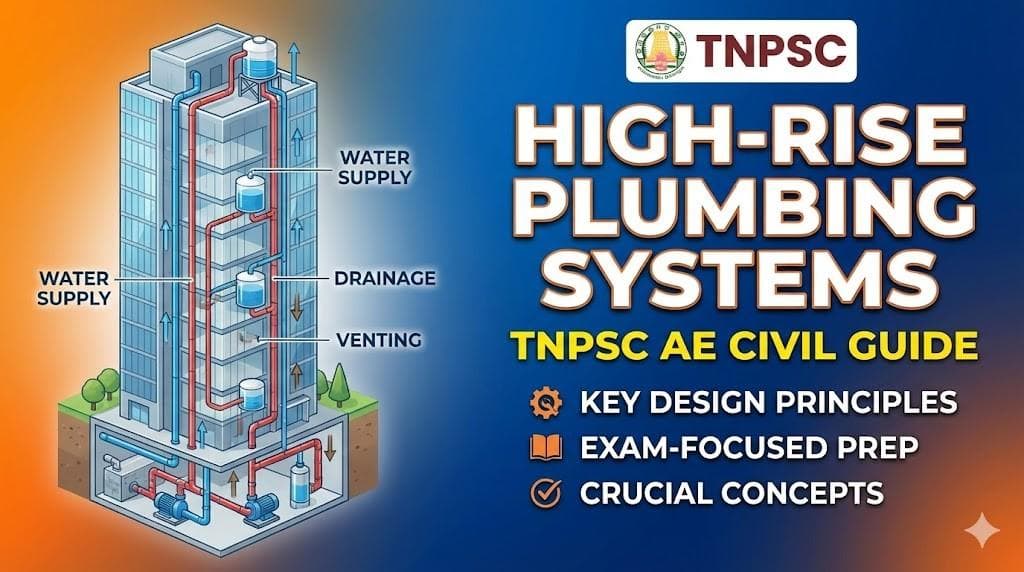
2. Water Supply Systems in High-Rise Buildings
Delivering water efficiently to all floors requires sophisticated systems:
a. Direct Pumping System (Hydro-pneumatic System)
- Pumps draw water directly from the main supply and deliver it to a pressure tank.
- Compressed air in the tank maintains pressure in the distribution network.
- Suitable for buildings of moderate height.
b. Up-feed and Down-feed System (Overhead Tank System)
- Water is pumped from the ground level to large overhead tanks (usually on the roof or intermediate floors).
- Water then flows down by gravity to fixtures on lower floors.
- Most common system for very tall buildings.
c. Zoned Systems
- For very tall buildings, a single plumbing system can lead to excessively high pressures at lower floors.
- Buildings are divided into vertical zones (e.g., lower, middle, upper).
- Each zone has its own independent water supply system, often involving pumps and intermediate tanks, to regulate pressure within acceptable limits (typically 3-5 bar).
- Pressure reducing valves (PRVs) are also used to control pressure within zones.
3. Drainage Systems in High-Rise Buildings
Efficiently removing wastewater is critical to hygiene and comfort.
a. Components of a Drainage System
- Soil Pipe: Carries human excreta from water closets.
- Waste Pipe: Carries wastewater from sinks, baths, showers (excluding human excreta).
- Vent Pipe: Maintains atmospheric pressure in the drainage system, preventing trap seal siphonage or blow-out.
- Trap: Water-filled bend that prevents foul gases from entering the building. Common types: P-trap, Q-trap, S-trap.
- Stack: A vertical main pipe (soil or waste) extending through one or more stories.
b. Types of Drainage Systems
- Single Stack System: Uses one main vertical pipe for both soil and waste, with a single vent pipe at the top. Less common in high-rises due to potential for trap seal loss.
- One-Pipe Partially Vented System: Uses a single main vertical pipe for soil and waste, but individual waste appliances are vented.
- Two-Pipe System (Fully Vented): The most reliable and preferred system for high-rise buildings. It consists of:
- One vertical stack for soil waste (soil pipe).
- Another separate vertical stack for greywater (waste pipe).
- Each fixture is individually trapped and vented to a separate vent stack.
- Modified One-Pipe System: A compromise where soil and waste are combined into one stack, but separate vent pipes are provided for each W.C. and other fixtures are locally vented.
Sump Pumps: Essential for buildings with basements to collect and pump wastewater/stormwater to a higher drainage level.
4. Venting Systems
Vent pipes are vital for maintaining atmospheric pressure within the drainage system, preventing either a vacuum that can siphon water out of traps or positive pressure that can blow foul air into the building.
a. Types of Vents
- Stack Vent: The extension of a soil or waste stack above the highest connected branch, terminating to the atmosphere.
- Main Vent (Vent Stack): A separate vertical pipe connected to the drainage system that extends upwards to the atmosphere, protecting multiple fixture traps.
- Individual Vent: A vent pipe connecting a single fixture trap to the vent stack or stack vent.
- Common Vent: A single vent pipe serving two fixture traps.
- Circuit Vent: A vent connected to a horizontal drainage branch that serves multiple fixtures.
- Loop Vent: Similar to a circuit vent but connects back into the stack vent or main vent.
- Relief Vent: A vent pipe installed in parallel with a soil or waste stack to prevent excessive pressure fluctuations.
5. Hot Water Systems
High-rise buildings often employ centralized hot water systems with recirculation loops to ensure instantaneous hot water at fixtures, minimizing water wastage.
6. Materials Used in High-Rise Plumbing
- Water Supply Pipes: CPVC, PPR, Copper, Galvanized Iron (GI - less common now).
- Drainage Pipes: PVC, Cast Iron, HDPE.
- Fittings and Valves: Brass, Bronze, PVC, CPVC.
7. Key Design Considerations for AE Civil Exam
- Pressure Drop Calculation: Understanding how pipe diameter, length, and fittings affect water pressure.
- Flow Rate Determination: Sizing pipes based on fixture units and probable demand.
- Thermal Expansion: Accounting for expansion and contraction of pipes due to temperature changes.
- Noise Control: Designing systems to minimize water hammer and flow noise.
- Accessibility: Ensuring adequate access for maintenance and repairs.
- Water Conservation: Incorporating low-flow fixtures and potentially greywater recycling systems.
Conclusion
A thorough grasp of plumbing systems in high-rise buildings, encompassing water supply, drainage, and venting, is indispensable for the TNPSC AE Civil Exam. Focus on the principles of pressure management, different system configurations, the role of vent pipes, and the materials used. Understanding these concepts will not only help you excel in your exam but also prepare you for real-world engineering challenges.