
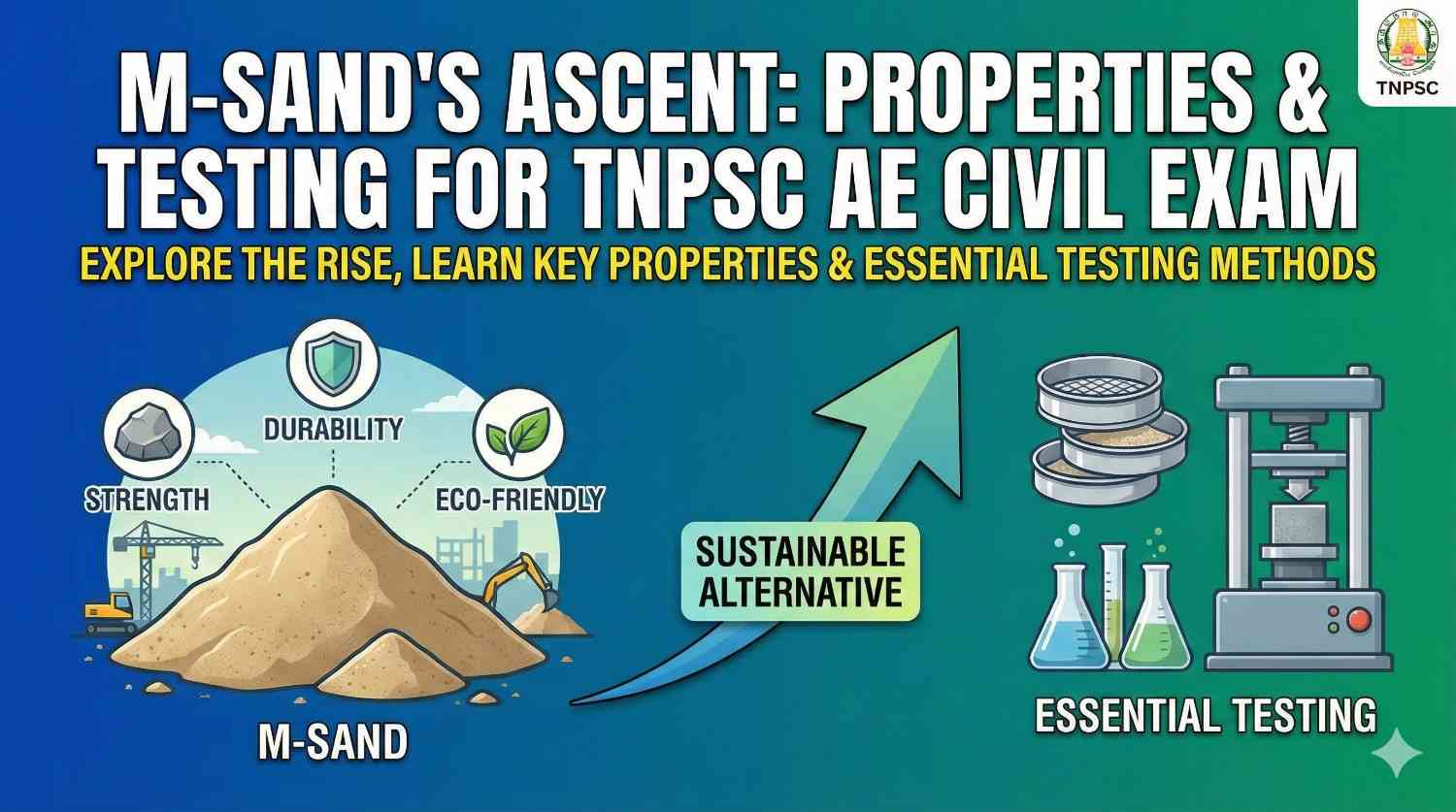
M-Sand: Properties & Testing for TNPSC AE Civil Exam
Table of Contents
The construction industry is constantly evolving, driven by the need for sustainable practices and efficient resource utilization. In this context, Manufactured Sand, commonly known as M-Sand, has emerged as a game-changer, especially in regions like Tamil Nadu. As river sand scarcity grows due to environmental concerns and over-extraction, M-Sand offers a reliable and eco-friendly alternative. For aspirants preparing for the TNPSC AE Civil Exam, understanding M-Sand's properties and testing protocols is not just academic but crucial for practical application and exam success.
What is M-Sand?
M-Sand is a substitute for river sand, produced by crushing hard granite rock into a fine aggregate. The crushing process ensures the sand particles are cubical or angular in shape, with graded sizes, similar to natural river sand. It's produced through a controlled process involving crushing, screening, and sometimes washing, ensuring consistent quality and desired physical properties.
Key Properties of M-Sand
M-Sand exhibits several distinct properties that make it a superior choice in many construction applications:
- Shape and Texture: Unlike naturally rounded river sand, M-Sand particles are typically angular and rough. This enhances the interlocking between aggregate particles, leading to higher compressive strength in concrete.
- Fineness Modulus: M-Sand can be produced with a consistent fineness modulus, which is critical for concrete mix design. It can be tailored to meet specific grading requirements (e.g., Zone II or Zone III as per IS 383:2016).
- Absence of Deleterious Materials: A significant advantage of M-Sand is the controlled production process, which minimizes the presence of silt, clay, organic impurities, and other deleterious materials that are often found in river sand and can compromise concrete quality.
- Strength and Durability: Concrete made with properly graded M-Sand often exhibits higher compressive strength, flexural strength, and better resistance to abrasion and weathering compared to concrete made with natural sand.
- Workability: Due to its angular shape and rough texture, concrete with M-Sand might require slightly more water or the use of superplasticizers to achieve desired workability. However, proper mix design accounts for this.
- Void Content: M-Sand tends to have a lower void content than natural sand, which can lead to denser concrete.
Advantages of Using M-Sand
The widespread adoption of M-Sand is driven by its numerous benefits:
- Environmental Sustainability: Reduces the dependency on river sand, preserving river ecosystems and minimizing illegal sand mining.
- Consistent Quality: Produced in controlled environments, M-Sand offers uniform particle size and quality, leading to more predictable concrete performance.
- Cost-Effective: Often more economical due to local availability and reduced transportation costs compared to river sand from distant sources.
- Enhanced Concrete Performance: Leads to stronger, more durable concrete structures.
Essential Testing of M-Sand for TNPSC AE Civil Exam
For the TNPSC AE Civil Exam, a thorough understanding of M-Sand testing methods is paramount. These tests ensure the M-Sand meets the required quality standards for construction projects:
- Sieve Analysis (Gradation Test) (IS 2386 Part I):Purpose: To determine the particle size distribution and fineness modulus of the M-Sand.
- Procedure: A known weight of dry sand is sieved through a set of standard sieves. The weight retained on each sieve is used to calculate the percentage passing, which helps determine the fineness modulus and conformity to IS 383 grading zones.
- Relevance: Crucial for mix design and ensuring adequate workability and strength.
- Specific Gravity & Water Absorption (IS 2386 Part III):Purpose: Specific gravity is used in mix design calculations. Water absorption indicates the porosity of the aggregate, which affects the water content in concrete.
- Procedure: Involves measuring the weight of saturated surface-dry (SSD) sand and oven-dry sand to calculate these values.
- Relevance: Important for accurate concrete mix proportioning and durability considerations.
- Silt Content / Clay Lumps / Fines Content (IS 2386 Part II):Purpose: To determine the percentage of very fine particles (silt and clay) which can negatively impact concrete strength and bond.
- Procedure: Typically involves a sedimentation method or a washing test, where fines are separated and measured.
- Relevance: High silt content (typically >3-5%) is detrimental and can lead to weak concrete.
- Organic Impurities Test (IS 2386 Part II):Purpose: To detect the presence of organic matter, which can retard the setting time of cement and reduce concrete strength.
- Procedure: Colorimetric test using a dilute solution of sodium hydroxide. The color of the solution after 24 hours is compared to a standard.
- Relevance: Organic impurities must be minimal as they interfere with hydration.
- Bulking of Sand Test:Purpose: Although less pronounced in M-Sand due to consistent grading, understanding bulking is important. Bulking is the increase in volume of sand due to the presence of surface moisture.
- Procedure: Involves measuring the volume of dry sand and then comparing it to the volume of the same sand with varying moisture content.
- Relevance: Essential for volume batching to avoid under-proportioning of sand.
Conclusion
The rise of M-Sand represents a positive shift towards sustainable and high-performance construction. For TNPSC AE Civil Exam aspirants, a comprehensive understanding of M-Sand's properties, advantages, and crucially, its standard testing methods, is indispensable. Mastering these concepts will not only aid in acing the examination but also prepare you for real-world engineering challenges, contributing to robust and sustainable infrastructure development.