Master Chain & Compass Surveying for TNPSC AE Civil Success
Table of Contents
Dear TNPSC AE Civil Aspirants,
Surveying forms a cornerstone of civil engineering, and a thorough understanding of its fundamental methods, especially chain and compass surveying, is crucial for excelling in the TNPSC AE Civil Exam. This comprehensive guide will equip you with the knowledge needed to master these topics and confidently tackle related questions.
1. Chain Surveying: The Art of Triangulation
Chain surveying is the simplest method of surveying, primarily used for flat areas and small plots. Its fundamental principle is triangulation, where the area is divided into a series of well-conditioned triangles (angles between 30° and 120°), and their sides are measured directly.
Key Instruments:
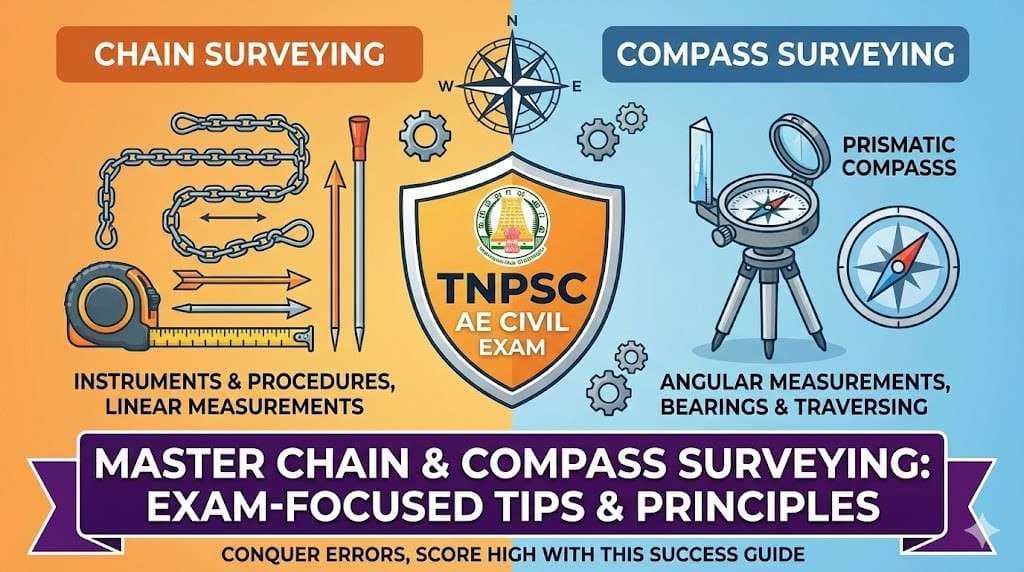
- Chain/Tape: For measuring distances (Metric chain, Gunter's chain, Steel tape).
- Ranging Rods: For establishing intermediate points and aligning survey lines.
- Arrows/Pins: To mark the end of each chain length.
- Pegs: To mark survey stations.
- Plumb Bob: For accurately transferring points to the ground and ensuring verticality.
- Cross Staff/Optical Square: For setting out right angles (offsets).
Procedure:
- Reconnaissance: Preliminary inspection of the area to identify suitable stations and obstacles.
- Establishing Survey Stations: Marking main stations and tying them with a network of triangles.
- Ranging: Aligning the chain along the survey line using ranging rods.
- Chaining: Measuring the length of survey lines.
- Offsetting: Measuring perpendicular distances from the main survey line to features (buildings, trees, etc.) using offsets (short offsets <15m, long offsets >15m).
Errors & Corrections:
Errors in chain surveying can be instrumental, natural, or personal. Key corrections include:
- Sag Correction: Due to the chain/tape sagging under its own weight (always subtractive).
- Temperature Correction: Due to expansion/contraction of tape (additive or subtractive based on temperature difference).
- Slope Correction: To reduce inclined measurements to horizontal (always subtractive).
- Pull Correction: Due to non-standard pull applied.
2. Compass Surveying: Navigating with Bearings
Compass surveying employs a compass to determine the bearings (angles with respect to the magnetic meridian) of survey lines and a chain or tape to measure their lengths. It's ideal for areas where triangulation is difficult due to undulating terrain or numerous obstacles.
Key Instruments:
- Prismatic Compass: Used to measure Whole Circle Bearings (WCB) directly.
- Surveyor's Compass: Used to measure Quadrantal Bearings (QB).
- Tripod: To mount the compass stably.
- Ranging Rods: For sighting.
Types of Bearings:
- Whole Circle Bearing (WCB): Measured clockwise from the North meridian (0° to 360°).
- Quadrantal Bearing (QB)/Reduced Bearing (RB): Measured eastward or westward from North or South, whichever is nearer (0° to 90°). E.g., N30°E, S45°W.
Important Concepts:
- Fore Bearing (FB) & Back Bearing (BB): FB is the bearing of a line measured in the direction of progression; BB is measured in the opposite direction. For a line AB, FB of AB = BB of BA. Ideal relation: BB = FB ± 180° (use + if FB < 180°, - if FB > 180°).
- Local Attraction: A disturbance of the magnetic needle caused by local magnetic substances (iron objects, electric wires). Detection: If FB - BB is not exactly 180° (allowing for observational errors), local attraction is present. Correction: Identify unaffected stations and adjust bearings systematically.
- Magnetic Declination: The horizontal angle between the true meridian and the magnetic meridian. It varies with time and location.
Traverse & Adjustment:
A series of connected lines whose lengths and bearings are measured form a traverse. Traversing can be open or closed. For closed traverses, closing errors (due to plotting not closing perfectly) are distributed using methods like Bowditch's Rule (for linear and angular errors) or Transit Rule (for angular errors being more precise).
3. Exam Relevance for TNPSC AE Civil
- Numericals: Expect questions on converting WCB to QB and vice-versa, calculating missing bearings, correcting for local attraction, and basic area calculations from chain lines and offsets.
- Conceptual Questions: Understand the principles (triangulation vs. traversing), instrument uses, sources of error, and when to apply specific corrections.
- Formulas: Memorize formulas for sag, temperature, slope, and pull corrections. Know the relationship between FB and BB.
- Identification: Be able to identify instruments and their specific functions.
Mastering chain and compass surveying requires not just theoretical knowledge but also the ability to apply concepts to practical scenarios. Practice numerical problems regularly and review the principles thoroughly.
Good luck with your TNPSC AE Civil preparation!