Self-Compacting Concrete: TNPSC AE Civil Exam Essential
Table of Contents
In the dynamic world of civil engineering, innovation constantly reshapes construction practices. One such groundbreaking advancement is Self-Compacting Concrete (SCC). For aspiring Assistant Engineers preparing for the TNPSC AE Civil Exam, understanding SCC is not just a plus; it's an absolute necessity. Let's delve into what makes SCC a revolutionary material and why it's a hot topic for your exam.
What is Self-Compacting Concrete (SCC)?
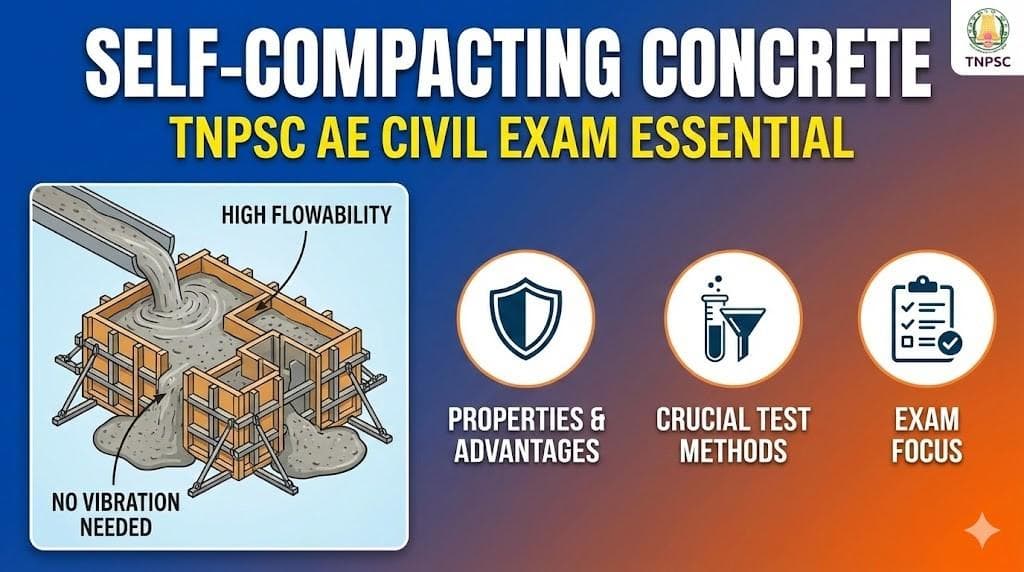
Self-Compacting Concrete, as the name suggests, is a highly fluid concrete that can flow under its own weight and completely fill the formwork, even in congested reinforcement areas, without the need for external vibration. It compacts solely by means of its self-weight, achieving full consolidation and void-free construction.
Key Properties and Advantages of SCC:
- High Workability: The most defining characteristic is its exceptional flowability, achieved without segregation.
- Elimination of Vibration: This reduces noise pollution on site, improves safety, and speeds up construction.
- Improved Quality and Durability: SCC leads to a superior surface finish, fewer honeycombs, and a more uniform, dense concrete, enhancing the durability of structures.
- Faster Construction: Reduced labor for compaction and quicker placement cycles.
- Economical: Though initial material costs might be higher, overall project costs can be reduced due to faster construction, reduced labor, and fewer repairs.
- Enhanced Safety: Less need for personnel in dangerous, confined spaces for vibration.
Composition of SCC:
SCC typically has a higher proportion of fine aggregates and a lower coarse aggregate content compared to conventional concrete. The magic lies in the use of:
- Superplasticizers (High-Range Water Reducers): These chemicals impart high flowability without adding excessive water, thus maintaining strength.
- Viscosity Modifying Admixtures (VMAs): Used to enhance segregation resistance and control bleeding.
- High Fines Content: Achieved through mineral admixtures like fly ash, ground granulated blast-furnace slag (GGBS), silica fume, or limestone powder, which contribute to workability and stability.
Essential Test Methods for SCC (Crucial for TNPSC AE):
Unlike conventional concrete, SCC’s fresh properties are evaluated differently due to its unique flow characteristics. Expect questions on these methods:
- Slump Flow Test: Measures the spreading ability (flowability) of SCC. A typical slump flow diameter ranges from 650-800 mm.
- J-Ring Test: Evaluates the passing ability of SCC through congested reinforcement. It measures the difference between slump flow and the flow through a J-Ring.
- V-Funnel Test: Determines the filling ability (flow rate) of SCC by measuring the time it takes for concrete to flow out of a V-shaped funnel.
- L-Box Test: Assesses the passing ability and filling ability of SCC through a confined space, simulating flow around obstacles.
- GTM Screen Stability Test: Checks the segregation resistance of SCC.
Applications of SCC:
- Complex and heavily reinforced concrete structures (e.g., bridge decks, tunnels).
- Precast concrete elements.
- Repair and rehabilitation work.
- Underwater concreting.
- Architectural concrete for superior finishes.
SCC for TNPSC AE Civil Exam: What to Remember
- Definitions and Principles: Understand why SCC doesn't need vibration.
- Key Admixtures: Focus on superplasticizers and VMAs.
- Test Methods and their Purpose: This is paramount. Know what each test measures and typical ranges.
- Advantages: Be able to list the benefits over conventional concrete.
- Distinguishing Features: Higher fines content, lower coarse aggregate.
Self-Compacting Concrete represents a significant leap forward in construction technology, offering numerous benefits in terms of quality, speed, and safety. For your TNPSC AE Civil Exam, a thorough understanding of SCC's properties, composition, and especially its unique test methods will be invaluable. Master this topic, and you'll be well-prepared for any question that comes your way!