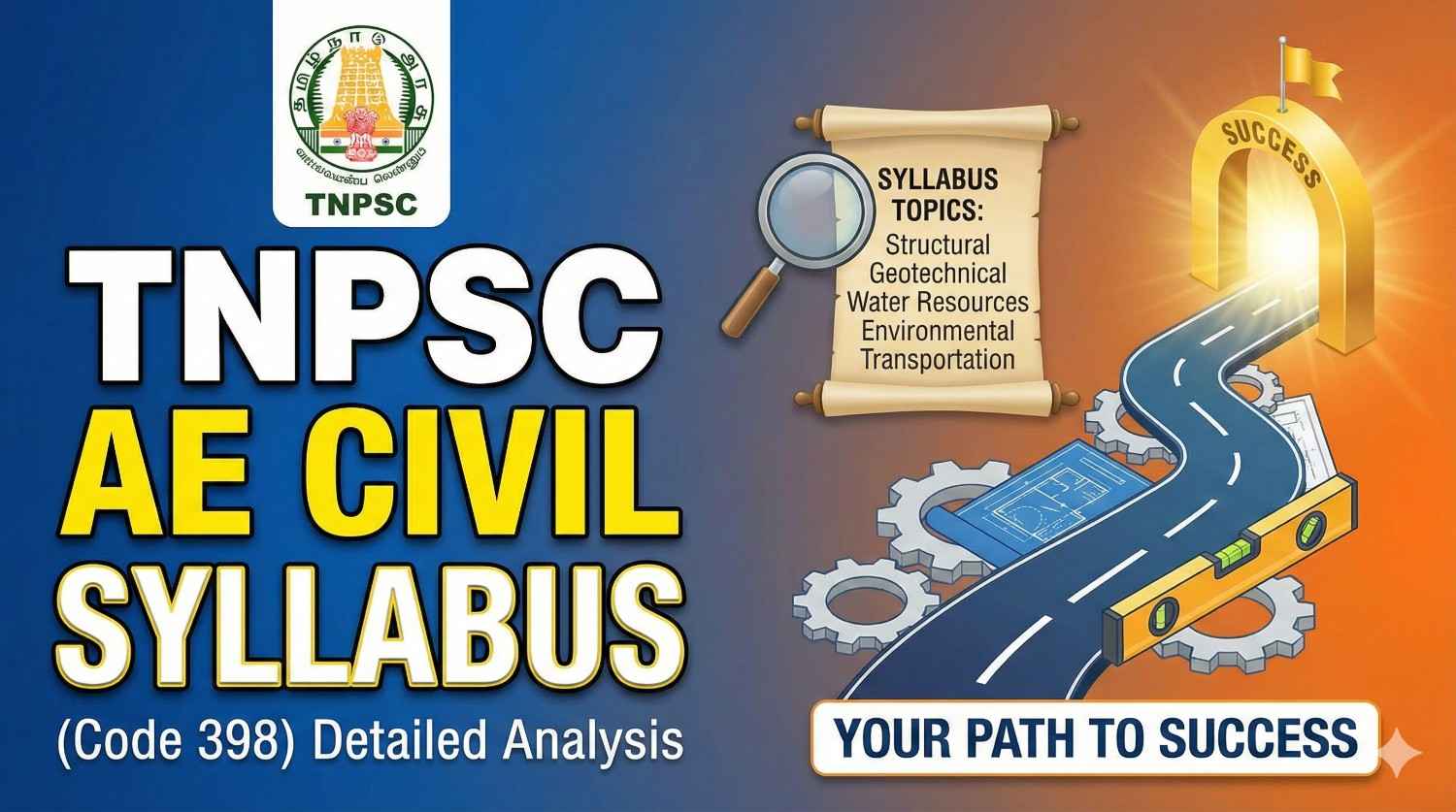
TNPSC AE Civil Syllabus (Code 398) Detailed Analysis: Your Path to Success
Table of Contents
The Tamil Nadu Public Service Commission (TNPSC) Assistant Engineer (AE) examination is a highly sought-after opportunity for civil engineering graduates aspiring to join government service. A thorough understanding of the syllabus is the bedrock of a successful preparation strategy. This detailed analysis focuses on the TNPSC AE Civil Engineering syllabus (Subject Code 398), helping you navigate the vast curriculum and prioritize your studies.
Understanding the TNPSC AE Civil Syllabus (Subject Code 398)
The Civil Engineering syllabus for TNPSC AE is extensive, covering core concepts taught across undergraduate civil engineering programs. It's broadly categorized into the following major subjects:
1. Building Materials and Construction Practices
- Building Materials: Properties and uses of stones, bricks, cement, aggregates, timber, steel, aluminum, glass, plastics, paints, varnishes, admixtures. Manufacturing processes.
- Construction Practices: Masonry, plastering, scaffolding, shoring, underpinning, formwork, damp proofing, sound proofing, fire proofing, concrete technology (mix design, properties of fresh and hardened concrete), pre-stressed concrete.
2. Structural Analysis
- Analysis of determinate and indeterminate structures (trusses, beams, frames).
- Methods: Slope deflection, moment distribution, stiffness matrix, flexibility matrix.
- Influence lines for beams and frames. Arches. Matrix methods of structural analysis.
3. Strength of Materials (Mechanics of Solids)
- Stress and strain, Hooke's Law, elastic constants.
- Shear force and bending moment diagrams for beams.
- Bending and shear stresses in beams. Torsion of circular shafts.
- Principal stresses and strains. Theories of failure. Deflection of beams. Columns and struts.
4. Reinforced Concrete Structures (RCC)
- Limit state design philosophy.
- Design of beams (singly and doubly reinforced), slabs (one-way and two-way), columns, footings, staircases.
- Retaining walls, water tanks. Detailing of reinforcement.
5. Steel Structures
- Design philosophy (Working Stress and Limit State Design).
- Design of tension members, compression members (columns, struts), beams, plate girders, trusses.
- Connections: Bolted and welded connections. Industrial buildings.
6. Fluid Mechanics and Hydraulics
- Properties of fluids, fluid statics, kinematics and dynamics.
- Flow through pipes (losses, Darcy-Weisbach, Hazen-Williams), open channels (Manning's, Chezy's), orifices, weirs.
- Hydraulic machines: Pumps and turbines (classification, principles, efficiency).
7. Soil Mechanics and Foundation Engineering
- Properties of soil: Index properties, classification, compaction.
- Effective stress principle, permeability, seepage analysis.
- Consolidation, shear strength of soils. Earth pressure theories.
- Foundation types: Shallow foundations (footings, rafts), deep foundations (piles, caissons). Site investigation.
8. Environmental Engineering
- Water supply engineering: Sources, quantity estimation, quality parameters, treatment processes (coagulation, flocculation, sedimentation, filtration, disinfection). Distribution systems.
- Wastewater engineering: Characteristics, collection systems, treatment processes (primary, secondary - activated sludge, trickling filter, tertiary). Sludge disposal.
- Solid waste management, air pollution, noise pollution.
9. Surveying
- Principles of surveying, types of measurements (linear, angular).
- Chaining, compass surveying, plane table surveying, levelling.
- Theodolite surveying, traverse computations. Contouring.
- Modern surveying instruments: Total Station, GPS, remote sensing, GIS fundamentals.
10. Highway Engineering
- Highway planning and development, alignment.
- Geometric design of highways: Cross-sectional elements, sight distance, horizontal and vertical curves.
- Traffic engineering: Studies, traffic control devices.
- Pavement materials (bitumen, aggregates), design of flexible and rigid pavements. Highway construction and maintenance.
11. Irrigation Engineering and Water Resources Engineering
- Hydrology: Precipitation, infiltration, runoff, hydrographs.
- Irrigation methods, water requirements of crops. Canals, cross-drainage works.
- Dams (types, design principles), weirs, barrages. River training.
- Groundwater hydraulics, well design.
Effective Preparation Strategies
Mastering this comprehensive syllabus requires a strategic approach:
- Understand Fundamentals: Build a strong conceptual base in every subject. Don't just memorize formulas.
- Prioritize & Weightage: While all subjects are important, some carry more weightage historically. Analyze previous year papers to identify frequently asked topics.
- Practice Numericals: Civil Engineering exams often have a significant numerical component. Regular practice is crucial.
- Refer Standard Textbooks: Stick to reputed textbooks for in-depth understanding and problem-solving.
- Solve Previous Year Papers: This is indispensable. It helps understand the exam pattern, question types, difficulty level, and time management.
- Mock Tests & Revision: Regularly attempt mock tests to simulate exam conditions and identify weak areas. Consistent revision is key to retaining information.
- Time Management: Develop a study schedule and stick to it. Allocate sufficient time for each subject based on its difficulty and importance.
The TNPSC AE Civil Engineering examination is challenging but achievable with dedicated effort and a smart study plan. By systematically covering the syllabus, practicing consistently, and revising regularly, you can significantly enhance your chances of success. Good luck!