TNPSC Civil Engineering Syllabus: Full Guide (Code 398)
DEG STD.Civil Engg.TNPSC-AE
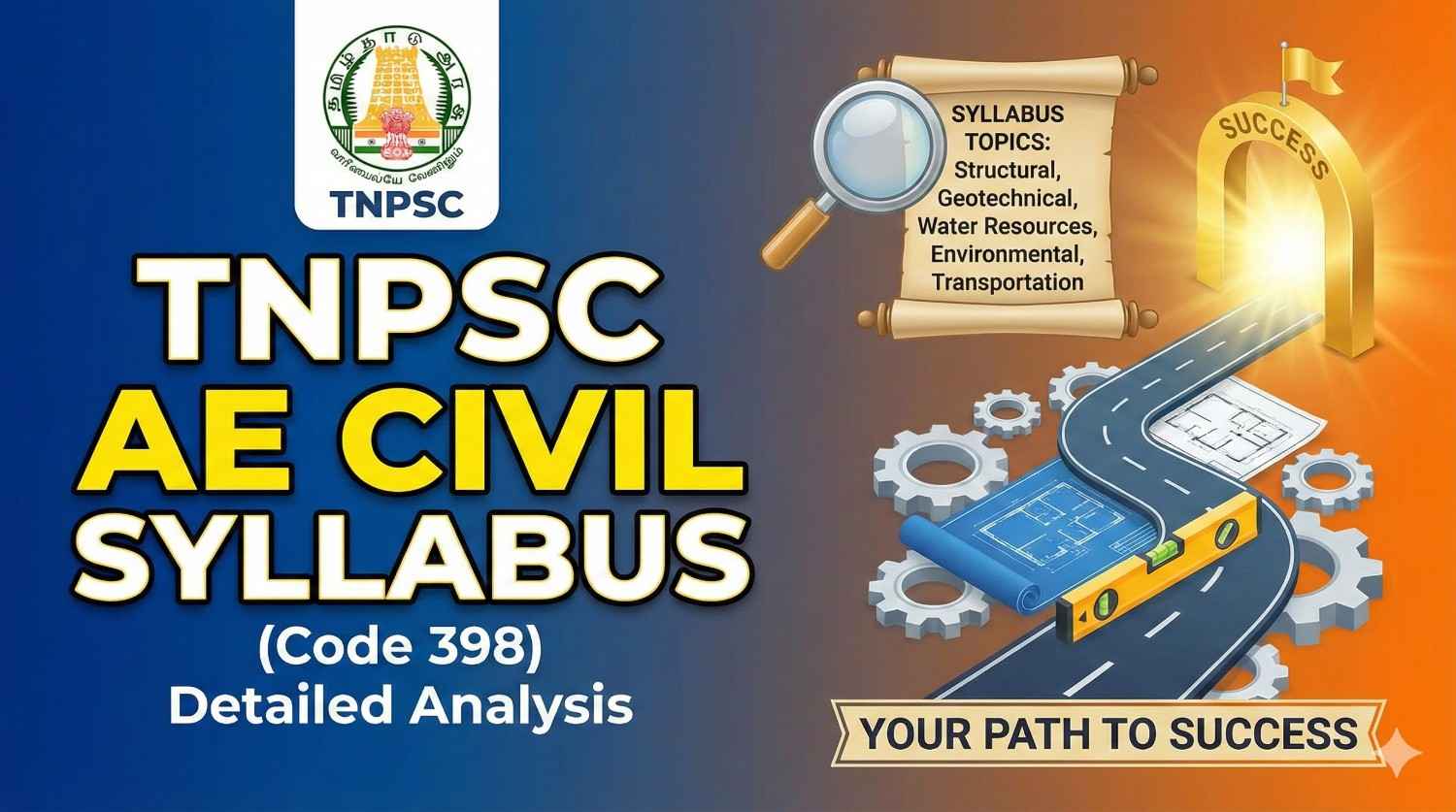
Complete TNPSC Civil Engineering Syllabus (Degree Standard). Detailed unit-wise topics and question distribution for Code 398 exam success.
Table of Contents
TNPSC Civil Engineering Syllabus
Standard: Degree Standard | Code: 398
Below is the detailed syllabus for the Tamil Nadu Public Service Commission (TNPSC) Civil Engineering exam. The syllabus is divided into 10 units with specific weightage given to each section.
UNIT I: Building Materials and Construction Practices 20 Questions
- Materials: Properties and testing of engineering materials (brick, stones, M-sand, aggregates, cement, timber).
- Modern Materials: Recycled materials, glass, plastic, FRP, ceramic.
- Concrete: Properties and testing, mix design, admixtures, Self-compacting concrete.
- Construction Practice: Stone masonry, brick masonry, R.C.C., and block masonry.
- Regulations & Safety: Construction equipment, building bye-laws and development regulations practiced in Tamil Nadu. Provisions for fire safety, lighting, ventilation, and Acoustics.
UNIT II: Engineering Survey 15 Questions
- Basic Surveying: Chain, Compass, Plane table, Levelling, Theodolite.
- Computations: Calculation of area and volume, L.S. and C.S., Contour.
- Advanced Methods: Traversing and traverse adjustment, Heights and Distances, Tacheometry, Triangulation.
- Modern Tech: Total Station, GPS, and Remote sensing techniques for surveying.
UNIT III: Engineering Mechanics and Strength of Materials 20 Questions
- Mechanics: Forces (types/laws), Centre of gravity, Moment of inertia, Friction.
- Stresses & Strains: Thermal stress, elastic constants, Combined stresses, stresses on inclined planes, Principal stresses and principal planes.
- Beams: Bending moment and shear force, Theory of simple bending, Deflection of beams, Torsion.
- Analysis: Theories of Failure, Analysis of plane trusses.
UNIT IV: Structural Analysis 20 Questions
- Methods: Indeterminate beams, Stiffness and flexibility methods, Slope deflection, Moment Distribution method, Matrix method.
- Structures: Arches and suspension cables, Theory of columns, Stability of retaining walls.
- Advanced Analysis: Moving loads and influence lines, Plastic theory, Seismic analysis of high-rise buildings.
UNIT V: Geotechnical Engineering 25 Questions
- Soil Properties: Formation, types, and classification of soils. Field identification, Physical properties, Three-phase diagram, Permeability characteristics, Stress distribution.
- Soil Mechanics: Theory of consolidation, Shear strength parameters, Compaction of soils.
- Foundations: Soil exploration and sampling (SPT, Borelog), Shallow foundations (Terzaghi's bearing capacity), Pile foundations (load tests, group action), Settlement of foundations.
- Stability & Improvement: Stability analysis of slopes, Ground Improvement techniques.
UNIT VI: Environmental Engineering and Pollution Control 15 Questions
- Water Supply: Sources, Water Demand, Characteristics/Analysis, Hydraulics of conveyance, Water-borne diseases.
- Treatment & Distribution: Design of water treatment plants, Desalination plants, Distribution systems, Pipe network analysis.
- Wastewater: Characteristics of sewage, Design of sewerage systems, Sewer appurtenances, Pumping, Sewage treatment and disposal.
- Other Systems: Stormwater drains, Plumbing in high-rise buildings, Industrial waste treatment.
- Pollution & Waste: Solid waste management, Air and Noise pollution control, E-Waste management.
UNIT VII: Design of RC, Prestressed and Steel Structures 30 Questions
- Reinforced Concrete: Limit state and working stress concepts. Design of slabs (one-way, two-way, flat), singly/doubly reinforced sections, flanged sections, columns, and footings.
- Pre-stressed Concrete: Systems and methods, post-tensioning slabs, Design for flexure.
- Steel Structures: Design of tension/compression members, bolted and welded connections, trusses, columns and bases, beams, plate girders, gantry girders.
- Special Structures: Liquid storage structures (elevated/underground), Retaining walls.
UNIT VIII: Hydraulics and Water Resources Engineering 20 Questions
- Hydraulics: Hydrostatics, Bernoulli equation applications, Pipe losses, Flow measurement, Open channel flow, Pumps (types/characteristics), Momentum equation, Kinematics of flow.
- Water Resources: Resources in Tamil Nadu, Planning, Master plan for management, Flood control, Runoff estimation, Hydrographs, Flood routing.
- Irrigation: Soil-plant-water relationship, Water requirement for crops, Irrigation methods, Design of alluvial canals and headworks, Water logging and land reclamation, Cross drainage works.
UNIT IX: Urban and Transportation Engineering 20 Questions
- Urban Planning: Urbanization trends, Slum clearance and improvement programs.
- Highways: Geometric design, Pavement materials (testing, alternate materials, modified binders), Design/Construction of bituminous and concrete roads, Pavement distress/evaluation, Maintenance.
- Railways: Permanent way components, Signalling, Interlocking, Train control, Drainage.
- Airports & Harbours: Airport planning, Site selection, Runways, Terminal buildings. Layout of harbours, Docks, Breakwaters.
UNIT X: Project Management and Estimation 15 Questions
- Management: Construction planning, Scheduling, Monitoring, Cost control, Quality control, Inspection.
- Analysis: Network analysis (CPM and PERT), Resource planning and management.
- Estimation & Contracts: Types of estimates, Technical specifications, Tender documents, e-tender, Building valuation, Laws relating to contracts and arbitration.