TNPSC JDO vs. AE: Navigating Your Engineering Career Path
Table of Contents
Are you an aspiring engineer in Tamil Nadu looking to secure a prestigious government job through the Tamil Nadu Public Service Commission (TNPSC)? Two popular technical roles that often come up are Junior Drafting Officer (JDO) and Assistant Engineer (AE). While both offer promising careers, they differ significantly in responsibilities, eligibility, and the nature of work. Understanding these distinctions is crucial for choosing the right path for your preparation.
Understanding the Junior Drafting Officer (JDO) Role
The Junior Drafting Officer position is typically advertised for departments like the Public Works Department (PWD), Highways Department, or Rural Development. It's a role that primarily focuses on the technical office work related to engineering projects.
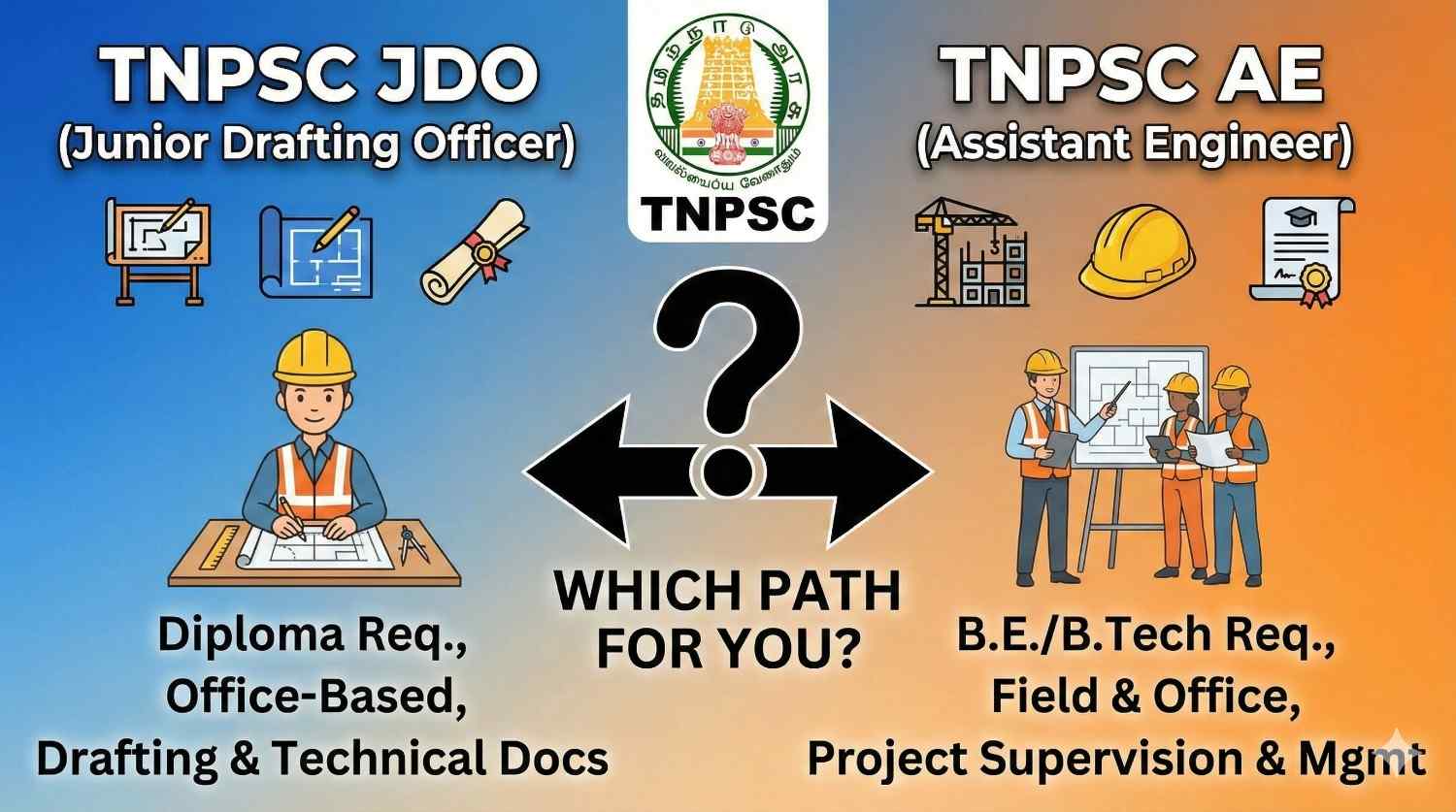
- Nature of Work: JDOs are mainly involved in preparing and scrutinizing technical drawings, plans, maps, designs, and estimates. They work closely with senior engineers to ensure accuracy in project documentation. This role is more office-based, requiring precision and attention to detail in drafting and calculation.
- Eligibility: The primary educational qualification for JDO posts is usually a Diploma in Civil Engineering (or a relevant discipline like Architectural Assistantship for some specific posts).
- Departments: Common departments include PWD, Highways, Water Resources Department, Rural Development and Panchayat Raj.
Understanding the Assistant Engineer (AE) Role
The Assistant Engineer post is considered a more senior and supervisory role compared to JDO, with a broader scope of responsibilities. AE positions are typically available in various government departments and corporations.
- Nature of Work: AEs are at the forefront of project execution and management. Their duties include supervising construction activities, ensuring quality control, preparing detailed project reports, managing budgets, conducting site inspections, and sometimes even leading a team of junior staff. This role often involves significant fieldwork and decision-making on-site.
- Eligibility: The fundamental educational requirement for AE posts is a Bachelor's Degree (B.E./B.Tech) in Civil Engineering, Mechanical Engineering, Electrical Engineering, or other specific engineering disciplines, depending on the department and vacancy.
- Departments: Popular departments include PWD, Highways, Tamil Nadu Generation and Distribution Corporation (TANGEDCO), Water Resources Department (WRD), Rural Development and Panchayat Raj, Municipal Administration and Water Supply, etc.
Key Differences at a Glance
| Feature Junior Drafting Officer (JDO) Assistant Engineer (AE) | ||
| Educational Qualification | Diploma in Engineering | B.E. / B.Tech in Engineering |
| Nature of Work | Primarily office-based; drafting, design, estimates, technical documentation. | Mix of field and office; project supervision, execution, management, quality control, decision-making. |
| Responsibility Level | Technical support; focus on accuracy of drawings and documents. | Supervisory and executive; responsible for project success and team leadership. |
| Career Progression | Can progress to Assistant Engineer equivalent roles with experience and further qualification. | Higher entry point; can progress to Executive Engineer and beyond. |
Which Exam to Prepare For?
The choice between preparing for the JDO or AE exam largely depends on a few critical factors:
- Your Educational Qualification: This is the most straightforward deciding factor. If you hold a Diploma, the JDO exam is your direct route. If you have a B.E./B.Tech degree, you are eligible for the AE exam, which is generally considered a higher-grade entry.
- Career Aspirations: Do you prefer detailed technical drafting and office-based work, or do you aspire to manage projects on-site, lead teams, and make executive decisions? JDO offers a path for the former, while AE caters to the latter.
- Syllabus and Competition: Both exams test your core engineering knowledge. However, the AE syllabus often covers subjects in greater depth and breadth, reflecting the higher responsibility of the role. Competition for AE posts can also be more intense due due to the higher qualification requirement and better pay scale.
- Exam Pattern: TNPSC exams for technical posts typically involve two papers: Paper I (Subject-specific, e.g., Civil Engineering) and Paper II (General Studies + Aptitude or General Tamil/English + Aptitude). While the format is similar, the difficulty and depth of Paper I will vary significantly between JDO and AE.
Preparation Strategy
Once you've decided which exam aligns with your qualifications and aspirations, here's a general approach to preparation:
- Thorough Syllabus Analysis: Download the official syllabus for your chosen exam and understand every topic.
- Strong Fundamentals: Build a solid foundation in your core engineering subjects. For JDO, focus on practical applications of drawing and basic design. For AE, delve deeper into theoretical concepts, design principles, and problem-solving.
- Practice Previous Year Papers: This is invaluable for understanding the exam pattern, question types, and time management.
- Current Affairs & General Studies: Don't neglect Paper II. Stay updated on current events and strengthen your general knowledge and aptitude skills.
- Consistency & Revision: Regular study and timely revision are key to retaining information and performing well under pressure.
Conclusion
Both TNPSC Junior Drafting Officer and Assistant Engineer roles offer stable and rewarding careers in the Tamil Nadu government. Your ultimate choice should be guided by your educational background, personal interests, and long-term career goals. Evaluate the differences carefully, align them with your strengths, and then dedicate yourself to focused preparation. Whichever path you choose, a career with TNPSC promises growth, stability, and the opportunity to contribute to the state's development.